Battery Technologies
There are many different battery technologies. In this tutorial, we only consider those suitable for small portable circuits.
LiPo batteries
LiPo batteries have the highest energy density (energy per volume and energy per weight). This makes them attractive in portable devices, because they are relatively light and small compared with other battery types of the same energy. However, they can catch fire if this energy is converted too quickly (e.g. in a short circuit). Home-made circuits with a LiPo battery must not simply be stored at the university. In the event of a fire caused by the LiPo battery of a device without CE certification, no insurance will pay for the damage. That is why you should never use LiPo batteries for your circuits during the prototype phase.
Most portable commercial devices, however, use LiPo batteries. That is why you should know their properties. The voltage of a LiPo battery changes relatively strongly with the SOC. A LiPo battery has approximately the following open-circuit voltage over the state of charge (SOC):
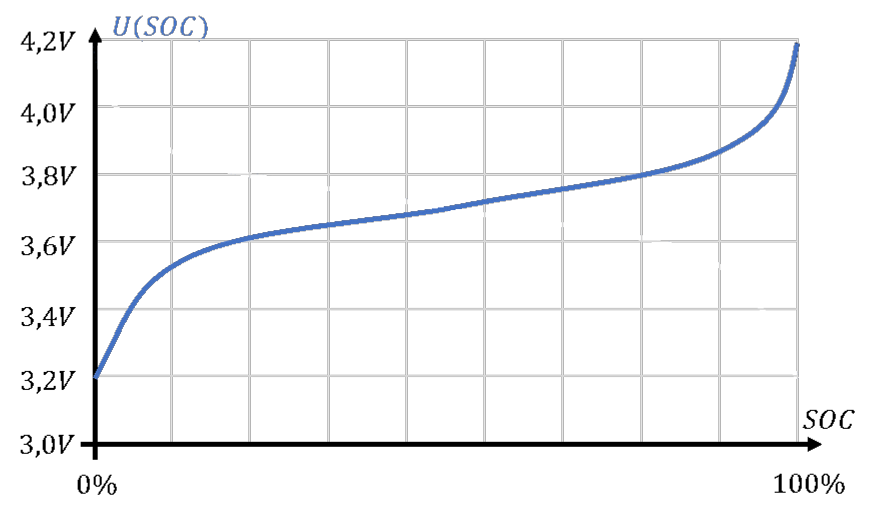
The usable range of the SOC lies between U = 3.2 V and U = 4.2 V. You should not operate a LiPo below 3.2 V, otherwise it ages much faster. That is why you should not keep draining your smartphone battery completely either.
NiMH batteries
From now on, in this tutorial we consider AA cells or AAA cells of the NiMH type. You can use them safely in prototypes and buy them in the supermarket. They have the following properties: