Complex Numbers
You know integers. These are numbers without a decimal point, i.e. numbers such as −6, 0, 120 or 1000. We calculate with these numbers in primary school. Then there are the real numbers. They fill the gaps. Examples of real numbers are 0.175, 3.5 or √2. Real numbers can be positive or negative. They are arranged on a number line. The further to the right we go on the number line, the larger the numbers become.
We can span a plane from two real number lines. We call one direction x and the other y. This is the plane in which you got to know vector calculus. You simply placed two real numbers orthogonally to each other. With two numbers – the x-component and the y-component – you now describe the position of a point in the plane.
Complex numbers extend the real numbers very much like the x-y plane. A complex number consists of two numbers, similar to the coordinates of a point in the plane. Only we do not name the directions x and y, but the real axis and the imaginary axis. Both axes are number lines of real numbers between −∞ and +∞ with 0 in the middle. However, the number on the imaginary axis gets a prefix: the i or the j.
The meaning of “j”
Mathematicians define i as the square root of −1. At school, you learned that no square root is defined for negative numbers. That is just as untrue as the claim that there are only integers. For the values in between, we defined the real numbers. Mathematicians define the number i as the square root of −1. You can express the square root of other negative numbers using i.
Complex numbers consist of a real number and an imaginary number. An example is the complex number Z = 3 + i2.
In electrical engineering, we use complex numbers for a great many applications. For us, the mathematicians' letter “i” is already taken by the current. That is why in electrical engineering we always use the letter “j” instead of “i” for the square root of −1. In electrical engineering, a complex number therefore looks like this: Z = 3 + j2.
The real part of a complex number is the value on the real axis. In the example of the number Z = 3 + j2, the value 3 is the real part. It is the number without j. The imaginary part is the value on the imaginary axis. In the example Z = 3 + j2, 2 is the imaginary part. We write the imaginary part as a real number, i.e. without the j. The j is implied for the imaginary number. It belongs to the axis, not to the number.
The complex plane
Complex numbers are represented graphically in the complex plane. The real axis points in the direction of the x-axis from vector calculus. The imaginary axis points in the direction of the y-axis. Complex numbers are points in the complex plane. Let us look at a few examples:
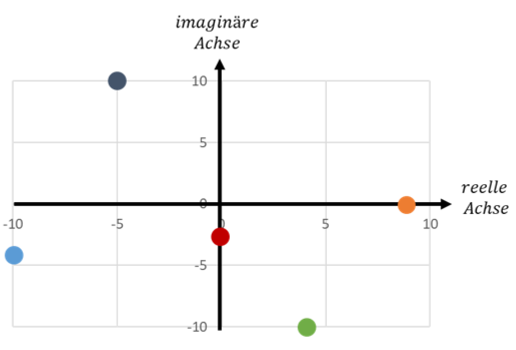
A purely real number is a special case of a complex number with imaginary part 0 (orange). A purely imaginary number has a real part of 0 (red). By convention, we write the real part first and the imaginary part after it.