Electric Field
Why do we use electronics in technology? Why does a smartphone not run on hydropower? After all, people have successfully realised their technical drives with it for thousands of years. What is the advantage of electronics that ensures it prevails practically everywhere?
In the chapter Energy we already found that we have to convert energy into another form if we want to move or illuminate something, for example. In classical mechanics there are some impractical limitations to this that we no longer even notice in everyday life:
A body that wants to move another body generally has to touch it. This is impractical, because cause and effect of a force must then be spatially close to each other, and there is friction and wear.
Another limitation of mechanics: the Earth attracts mass towards its centre. Let us imagine that we could briefly and locally "reverse" the Earth's attraction into a repulsion of variable intensity. Travelling into space would be much easier if, at Cape Canaveral, the Earth repelled the rocket for 2 minutes. Imagine you could pack up the Earth's gravity and take it with you to the ISS so that it acts there. The everyday world is severely limited compared with the possibilities of electronics.
Fields
To clarify how separated charge can be used technically, we must first describe the phenomenon "field": how does a flying aircraft actually know that it is attracted by the Earth? After all, it does not touch the Earth. How does the Earth's gravity get to the aircraft? How does the Earth attract the Moon, for example, without touching it? Physicists explain this with the term field.
Greatly simplified: every mass attracts other masses. We call this gravitation. The attractive force is so small that we only notice it with planets of extremely large mass. Every mass has a gravitational field in which this attractive force acts. If another mass is in this field, the force of the field acts on that mass. So the Earth attracts the Moon because the Moon lies within its gravitational field.
We know this from magnets, which also exert forces via fields. A magnet always has a field, regardless of whether there is something nearby to attract. If a piece of iron is brought close to the magnet, it is attracted. From a certain distance, the attractive force is greater than the forces preventing it from moving (e.g. friction on the floor), and it moves towards the magnet. After that, the piece of iron sticks to the magnet until the end of time.
A field always decreases with distance from its source. The further we move away from the Earth, the smaller the Earth's attraction on a mass. With a magnet, this dependence on distance can be shown very easily in an experiment.
Aside: How does this work with energy? Doesn't the magnet get weaker at some point? How can it last so long and, in theory, hold the piece of iron forever without any energy being supplied? Physicists say that energy is defined as force times distance. The following applies:
A field only produces a force F. As long as nothing moves, this force can be maintained forever without any change in energy. The movement of the iron towards the magnet is a change in position ds. Together with the force, it changes the energy in the system. After the movement, this state (magnet sticking to the iron) is maintained until a new change is made to the system from outside. Without movement there is no change in position ds, so force times change in position equals 0. A force due to a field is maintained by a mass (gravitational field) or a magnet (magnetic field) without any expenditure of energy.
An example: a stone lies on a table in the gravitational field on the Earth's surface. Does its potential energy change because it is lying on the table? No, it obviously does not. But the stone is attracted by the Earth with the gravitational force all the time. So there is a force without the energy in the system changing. You notice the force when you take the table away. Then the stone falls down. Then we have a force and a change in position, and so the potential energy of the stone decreases and is converted into the kinetic energy of the movement. In a technical system, the change in position is often deliberately prevented or enabled. The force is often continuously present.
Every system strives for the state of minimal energy. A stone falls down because it has less potential energy there than further up. The drive or motivation for every movement lies in this principle. When the stone is lifted, the energy in the system increases. For this, energy must be supplied to the system from outside. The energy for the movement is the difference between the energies in the system before and after the movement.
The electric field
One reason for the success of electronics is the possibility of creating fields artificially. If charges of different polarity are separated (i.e. positive and negative charges), an "electric field" arises between them. Just as gravitational fields are caused by masses and act on masses, electric fields are caused by separated charges and act on charges.
As in the chapter Charge we mentally move a charge from one body to another. The two bodies are now charged differently, one positively and the other negatively. A force acts on the charge that has just been moved, pulling it back to its "own" body. This force acts without contact via a field.
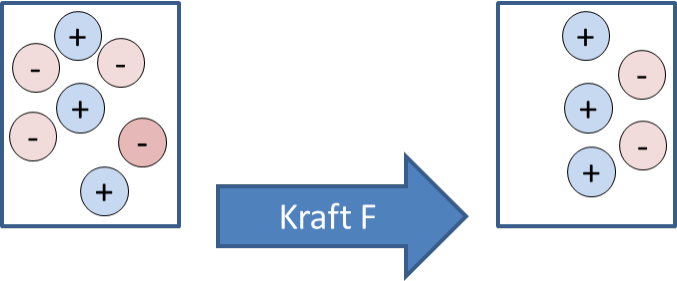
If there is no electrically conductive connection between the bodies through which the charge could move, the imbalance remains permanently. So the field and the force remain too. The table on which the stone lies prevents the stone from moving towards the centre of the Earth. Without a path for movement, the stone stays on the table forever, even though it is pulled downwards.
The Earth's gravitational field always acts towards the centre of the Earth. We illustrate the direction of action of a field with field lines. Field lines point in the direction in which the force acts, i.e. in which a movement would take place. The electric field always points from the positive to the negative separated charge. So its field lines point in the direction in which a force acts on a positive charge. The following figure shows the Earth's gravitational field and the electric field of a negative point charge:
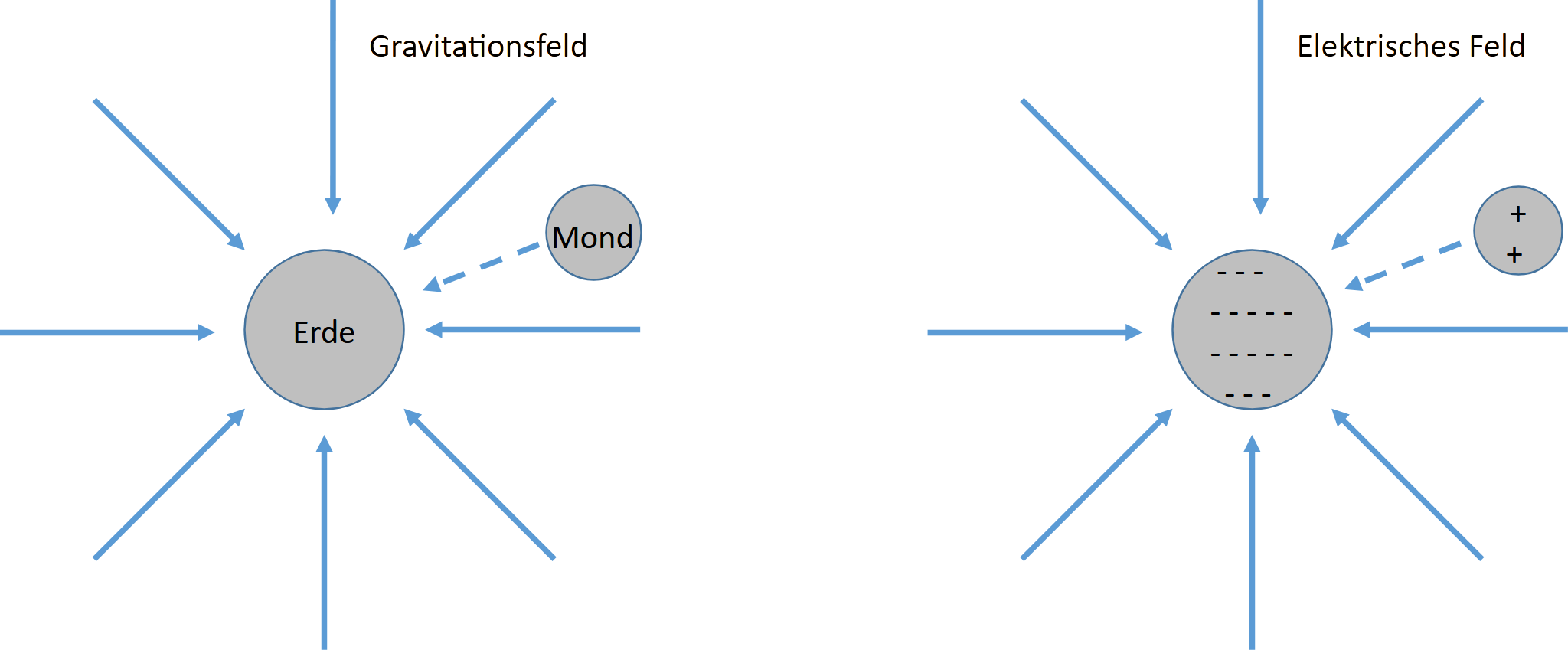
The mechanism by which the Earth attracts the Moon is the same as the one by which opposite charges attract each other.
Imagine two metal plates facing each other. We now separate the charge so that one plate is positively charged and the other negatively. As a result, an electric field forms between the plates. The field exerts a force on charges between the plates. A positive charge located between the plates is attracted towards the negatively charged plate.
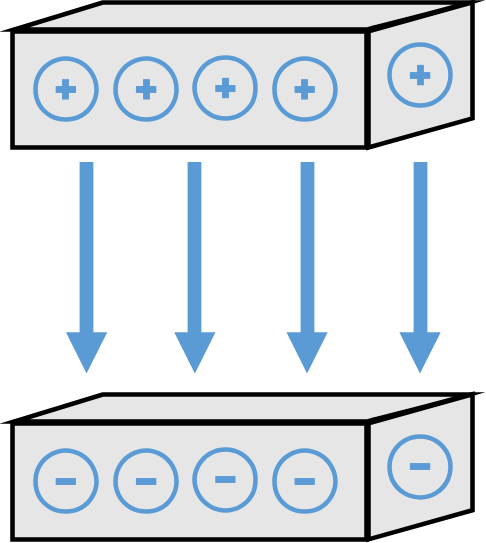
We can orient these plates in space as we like. We can reverse the direction of the field by reversing the charges on the plates. We can separate the charges in one place and take the plates to another place, where the field then acts. It does not matter when the field was created and when we use it. We can even change the intensity and polarity of the field over time; then the field is no longer constant in time.
Greatly simplified, a battery contains such a field of separated charges stored in two chambers.
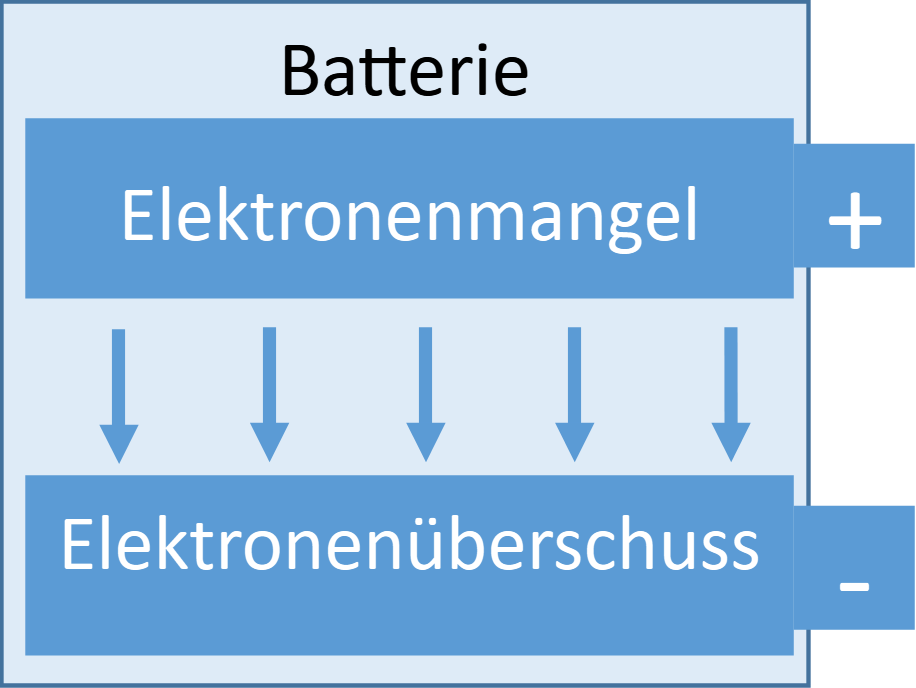
We can simply carry the field (i.e. the battery) around with us. The charge does not even have to be between the plates for the force to act on it. We can conduct the force effect of the field from the plates via cables, e.g. into an LED. We can operate complex circuits such as a smartphone with a single battery, and inside there are hundreds of modules in which charge is moved to operate something. Compared with the Earth's gravitational field, the electric field is therefore extremely flexible. This property makes electronics so attractive for technical solutions.
Charge separation in electronics
If we understand how these fields are used in electronic systems, we can also really understand their use in practice. For simplicity, we consider systems in which a great deal of charge is separated and only very little of this charge is balanced again. When you operate a torch with a battery, an extremely large amount of charge is separated in the battery. The lighting of the LED in the torch balances only very little of this separated charge. Otherwise the battery would be empty immediately. Why do we do this? Because it decouples the cause of the field from its effect. Why is that important?
When two individual charges are separated, a field already arises. After the charges have been balanced, this field is gone again. So the charge creates its own field; it is at the same time the cause of the field and the object on which the field acts. That ties your brain in knots. And this idea is not helpful, because it does not correspond to what we generally have in practice.
If an extremely large amount of charge is separated between two bodies and we consider the balancing of a single charge, we can assume that the field is not changed by this single small charge balance. Cause and effect are separated. From now on we use this picture.
Further information
YouTube (in German)
Please ignore the formulas in the video and only pay attention to the principle.