Electric Field
Separated electric charges cause the electric field. The intensity of the field depends on how much charge Q is separated and how far apart the charges are. The general formula for the electric field strength E applies:
General electric field strength
| Physical quantity | Symbol | Unit name | Unit symbol |
|---|---|---|---|
| Electric field strength | \(\vec{E}\) | volt per metre | \(\dfrac{\mathrm{V}}{\mathrm{m}}\) |
The field strength is a vector. Its magnitude indicates the intensity of the field. By convention, its direction indicates the direction of the force acting on a positive charge. On a negative charge, the force of the field acts in the opposite direction. You should always determine the direction of action by thinking it through and not try to obtain it from this formula.
Let us first look at the field of a charge Q1 in space. We call a charge a point charge when the entire amount of charge is gathered on such a small area that the geometry can be regarded as a tiny point. This is the source of the electric field. The field acts in space. The further we move away from the source, the smaller the intensity of the field. Mathematically, this is expressed by the area A on which the field acts becoming larger. In our minds, let us place a hollow sphere around the point charge. The charge forms the centre of the sphere. Then all points on the surface of the sphere are equally far from the charge. The field acts equally intensively on all points of the sphere. From this we derive how the intensity of the point charge changes in space with the distance from the charge: we insert the formula for the surface of a sphere for A. The following special formula applies to the field of the point charge Q1:
Electric field strength of a point charge
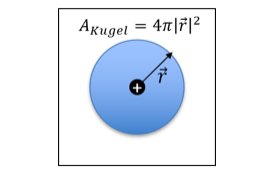
We now introduce a test charge Q2. The (assumed) positive point charge Q1 repels the positive test charge Q2. The direction of the force on Q2 then points radially away from the point charge in all directions. The direction of the force on a positive test charge corresponds to the direction of the field. That is why the direction vector of the field in the formula equals the direction of the radius r of the sphere. Important: this applies only to point charges. The formula for the field of the point charge gives the intensity of the field strength for all points on the surface of a sphere with radius r whose centre is the charge Q1.
If the point charge Q1 were negative, the force would point towards the point charge in all directions. The direction of the field is visualised with field lines. Field lines are arrows in space that indicate the direction of the field by the direction of the arrow. The figure below shows the fields of a positive and a negative point charge in space.
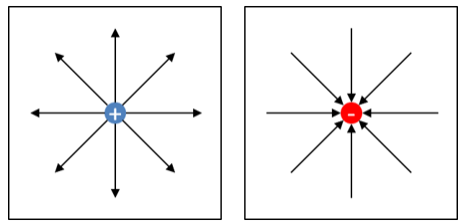
The intensity of the field is represented by the density of the field lines. Right at the point charges, many arrows per area are drawn. Further away, the density of the arrows decreases.
The electric field depends on the material between the charges. There are materials that let the field pass unchanged and other materials that attenuate it. This is expressed by the natural constant ε0 and the material parameter εr. For vacuum (and approximately also for air), εr = 1. The more a material attenuates the field, the greater εr becomes. So the following applies:
The material property of the field strength applies generally and independently of the geometry. We assume that the entire region between the charges is always filled with one material with one value of εr. Otherwise it gets a little more complicated.
Note on formulas for fields
As you have already seen in electrostatics: there are few general formulas and many applications to special geometries. Pay attention to which formulas are general and which are valid only in certain contexts. With fields, almost all formulas contain at least one geometry parameter which – depending on the context – leads to a different formula.