Applications of Electric Fields
This chapter describes typical applications for the technical use of electric fields.
Deflection of charged particles
When a charged particle flies between the plates of a capacitor, its trajectory is deflected by the electric field. An electrostatic force acts on the charged particles that is proportional to the charge of the particles.
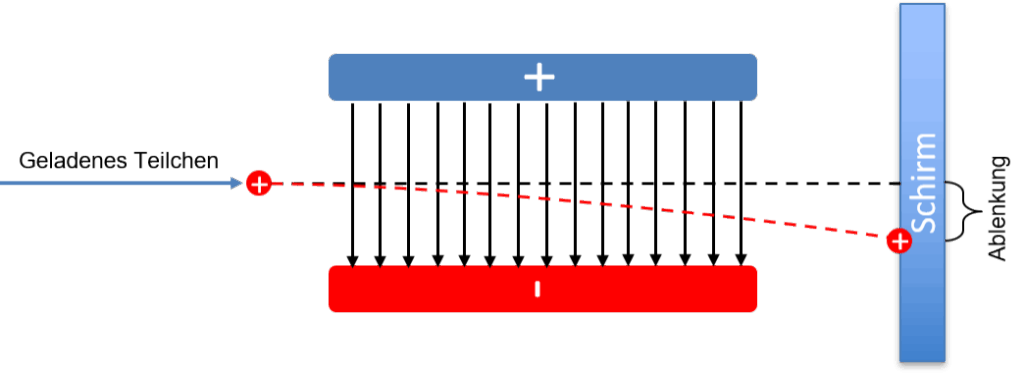
This experiment can be modelled as a point charge moving at uniform velocity through an electric field. Because the particle is repelled or attracted by the plates, a force F acts on the particle.
The deflection of the particle – and thus the change in its trajectory – depends on the charge and the mass of the particle. If this deflection is measured by measuring the position at which the particles hit a screen, the mass and charge of the particle can be deduced from the deviation of the point of impact from the centre of the screen.
Electrolysis
Ions are dissolved in a liquid. Ions are tiny charged particles that can move freely in the liquid. They can be modelled as point charges. Two metal rods (electrodes) are placed in this liquid and a voltage is applied to them. The voltage charges one metal rod positively and the other negatively. An electric field forms in the liquid between the electrodes. The metal rod with the positive potential (anode) attracts negatively charged ions. The one with the negative potential (cathode) attracts positively charged ions.
Because of the electrostatic forces, the ions move along the field lines towards the electrodes. The first figure shows the view from above, and the next figure shows the side view of the tank.
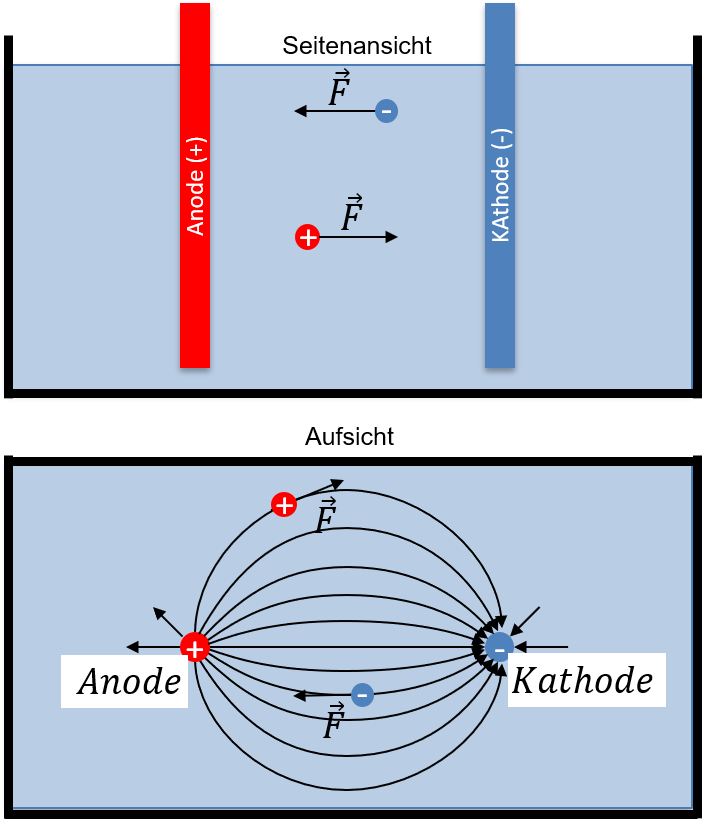
The movement of the ions through the liquid is a movement of charge, i.e. a current flow. This closes the circuit with the source. So electrons move from the source through cables into the cathode; from there, negatively charged ions move through the liquid to the anode, and from the anode electrons then move back to the source.
Over time, the ions accumulate at the electrodes, so that many positively charged ions gather around the cathode and many negatively charged ions at the anode. This accumulation prevents further current flow. This problem can be solved, for example, with an AC voltage instead of a DC voltage.
In electrolysis, water is split into hydrogen and oxygen. The positively charged hydrogen moves to the negatively charged cathode and rises there as a gas. The negatively charged oxygen moves to the positively charged anode and also rises there as a gas. The starting product, water, is liquid; the end products are both gaseous. That is why – apart from dirt – nothing accumulates on the electrodes during electrolysis.
Exercise: Which formula is used to calculate the electric field strength at a point in the liquid if the voltage at the electrodes is known? Assume that the electric field is homogeneous.
Think about which formula you can use to calculate the magnitude of the force on the ions. Assume that the magnitude of the field strength E at the location of the ion under consideration is known and that you know the position of the ion.
Flashover
If the electric field strength in air becomes too great, a conductive channel forms in the air (plasma) and a flashover occurs. Air is therefore a non-conductor until the field strength becomes too great. This happens, for example, when two bodies at different potentials are brought too close together. The field strength is calculated from the voltage according to
From a field strength of about 1kV per centimetre, air becomes conductive. So if you are standing next to a high-voltage line with a voltage U = 10kV, you should keep a distance of at least 10cm. This rough guideline applies to dry air; at high humidity the critical field strength is considerably lower, so please never even go near such lines. If the air is humid and the voltage is higher, even a distance of one metre can lead to a fatal flashover onto your body.
Lightning is a flashover between the clouds, which have become electrostatically charged by rubbing against each other, and the Earth. A conductive channel forms through the air, which can be several hundred metres long. Lightning shows you how destructive flashovers are for people and for technical systems. That is why we must always plan sufficient clearance in technical systems with high voltages.
Flashovers are the reason why the plate spacing of capacitors has a lower limit. The capacitance C of a capacitor cannot be increased arbitrarily by reducing the plate spacing d. The following applies:
A smaller spacing d leads to a larger capacitance C. The spacing d is limited at the lower end by the flashover strength, also called the “dielectric strength”, of the filling material between the plates. The maximum voltage (“voltage rating”) of a capacitor indicates the voltage up to which no flashover occurs inside the capacitor.