Inverter
In some cases your signal is negative, but you need a positive signal. If, for example, you amplify a positive sensor signal with an inverting amplifier, the signal at the output of the op-amp is negative. In such cases you can use the inverter. It multiplies the input signal by the factor v = −1. The inverter is an inverting amplifier with v = −1. You simply set R1 = R2.
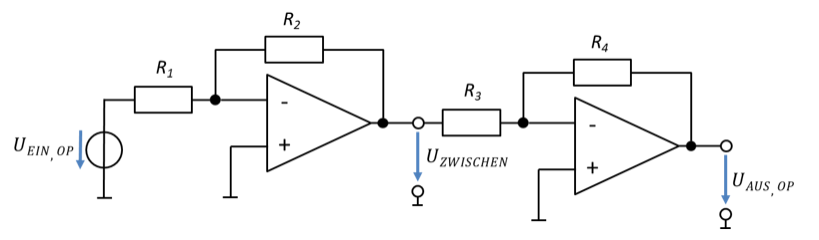
\[
\begin{gathered}
\text{Left amplifier: } U_{\mathrm{Zwischen}} = -\frac{R_2}{R_1} \cdot U_{\mathrm{Ein,OP}} < 0\,\mathrm{V} \\[6pt]
\text{Right amplifier: } U_{\mathrm{Aus,OP}} = -\frac{R_4}{R_3} \cdot U_{\mathrm{Zwischen}} > 0\,\mathrm{V} \\[6pt]
\text{Right amplifier as inverter with } v = -1\ (R_3 = R_4) \\[6pt]
U_{\mathrm{Aus,OP}} = -U_{\mathrm{Zwischen}}
\end{gathered}
\]
(Zwischen = intermediate.) With two inversions of a signal you obtain an overall positive gain. The inverter is always used when you have a negative signal whose sign you want to change without amplifying or attenuating it.