Sinusoidal Excitation
To investigate the time behaviour of stores, we need signals that vary over time. Sinusoidal signals are a natural choice in electrical engineering, since alternating currents are also sinusoidal. So we vary the inflow and the outflow sinusoidally over time. During the positive half-wave of the sine, only the inflow is open; the outflow is closed. The higher the instantaneous value of the sine, the further the inflow tap is opened. During the negative half-wave, the inflow is closed and the outflow is opened further the closer the instantaneous value gets to the negative peak value.
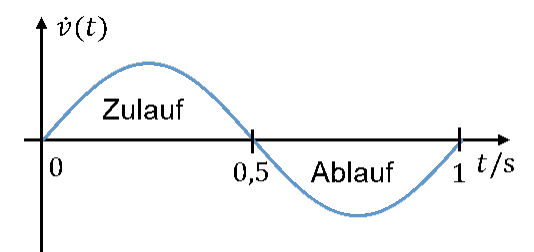
The graph shows a sinusoidal inflow and outflow of water at the bucket. Let us first look at the fill level of the bucket. The fill level reaches its maximum at the moment when the inflow has just been closed again. As long as water is still flowing in, the fill level continues to rise. The minimum is reached when the outflow has just been closed completely.
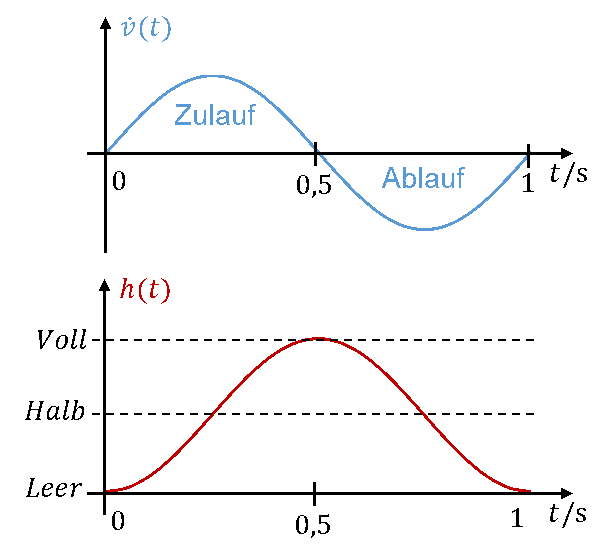
It becomes clear that the time curve of the fill level is shifted in time relative to the inflow. The time shift is a quarter of the period of the sine. You will receive further explanations of this in the topic of alternating current; the terms are not yet important here.
For a sinusoidal inflow and outflow of water, the following mathematical description results (for the sake of completeness): the water inflow can be described mathematically as
For alternating quantities, I omit the initial value of the fill level. The fill level h then follows the equation