Ideal Voltage Source
A voltage source provides a fixed voltage at its output. One example is a socket in a wall. The voltage at this socket is always 230 V, regardless of which load you connect. Loads such as a hair dryer draw a lot of power from the socket. A mobile phone charger draws much less power. Since the voltage is always the same, a large power requires a large current.
An ideal voltage source has an output voltage that is independent of the current flowing out of the source.
Modelling
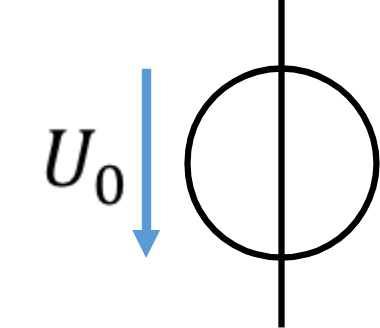
In an electrical circuit diagram, a voltage source is drawn as a circle with a vertical line. Next to this symbol for the source, an arrow for the direction of the voltage at the source and a label must always be used. The source has two terminals above and below the circle, to which other components can be connected.
Components are usually given an index in their label so that several components of the same type can be distinguished. There are then, for example, R1, R2, R3, etc.
In this tutorial, the index 0 is used for sources, which is why the variable U0 was used for the value of the voltage at the source. A model of a 9 V battery would therefore have a voltage of U0 = 9 V.
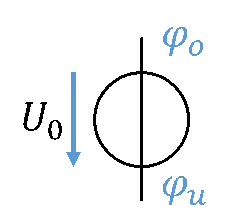
Above and below the source there are electric potentials of different magnitude. The voltage source contains separated charges. For the 9 V battery, the potential above the source φo is higher than the potential below the source φu by U0 = φo – φu = 9 V. Often the potential below the source is defined as the lowest potential of a circuit, i.e. as ground with φu = 0 V. The voltage source only ensures that there is a voltage between its terminals; it does not define the absolute level of the potentials at its terminals.
In an example, a resistor with R = 9 Ω is connected as a load to this ideal voltage source with U0 = 9 V. This is modelled as a simple circuit in a circuit diagram as follows: the voltage source is connected to the resistor by conductors.
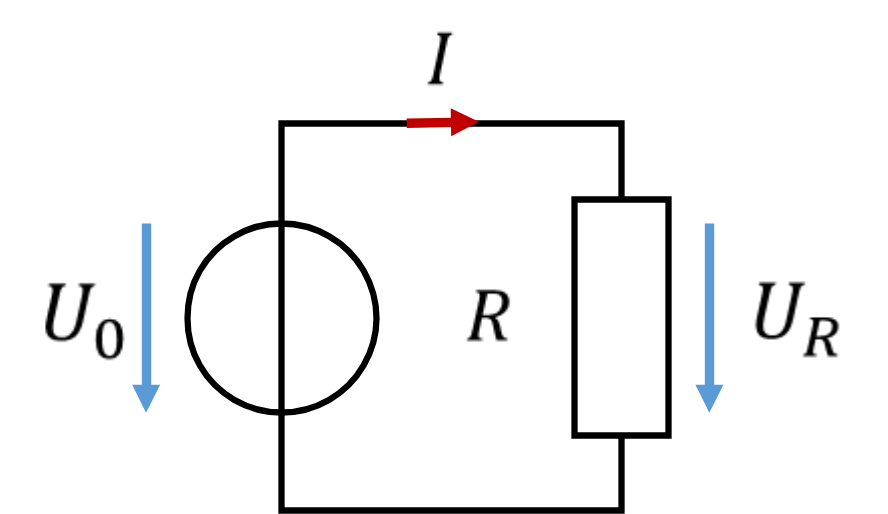
Then the following applies to the resistor:
If a resistor with R = 1 Ω is connected, the voltage across the resistor is still UR = 9 V, because the source voltage is independent of the load. But the current is now:
So the current flowing out of the source depends on the load.
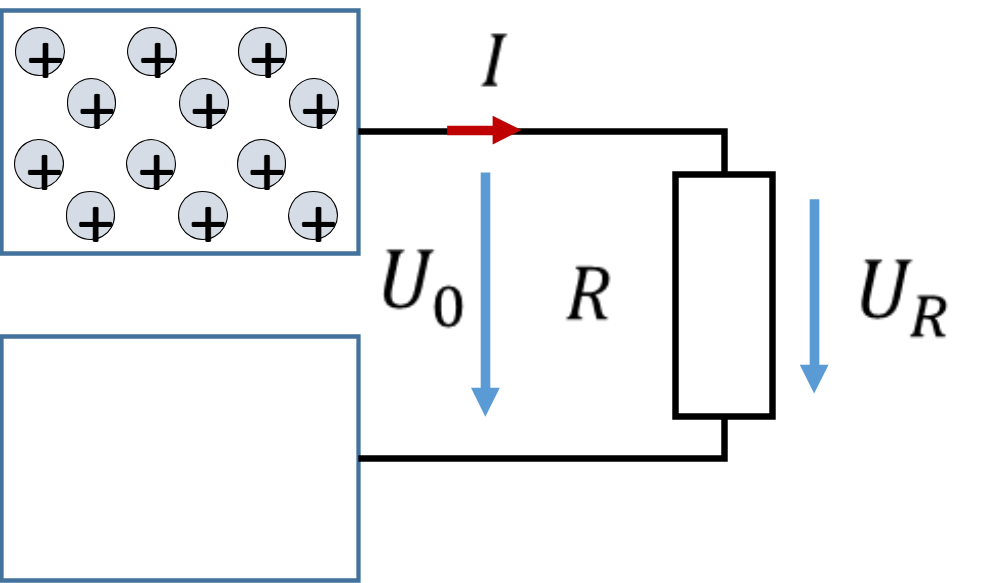
You can imagine an ideal voltage source as an infinitely large store of separated charges that never runs empty. The positive charges in the upper chamber flow through the load into the empty lower chamber.
Voltage sources are, for example, the socket, a battery or laboratory power supplies in the lab course.