Distribution of Electrical Energy
The grid distributes electrical energy to households. Each house has a grid connection from which the sockets are supplied.
The wires in the house wiring are colour-coded. The colours of the wires therefore have a meaning. Where colours have been used for signals in this tutorial so far, they never refer to wire colours. Confusing wire colours can be life-threatening. The following coding is used in house wiring (in Germany):
- green-yellow: protective conductor
- blue: ground, neutral conductor
- black: line conductor
- grey: line conductor
- brown: line conductor
The voltage of a socket with an RMS value of 230V in star connection is present, for example, between the black and the blue conductor. Three-phase current for the cooker and oven is present between the conductors coloured black, grey and brown.
The blue wire is at the earth potential of the power plant. With a symmetrical load, no current flows through the blue wire. Since there is no symmetrical load in the house, the blue wire is used as the return conductor for the current flowing through one of the line conductors.
The green-yellow protective conductor normally carries no current. Current flows through it only in the event of a fault. It is at the earth potential of the house.
Protection against electric shock
If a person touches one of the line conductors, they get an electric shock. A voltage is then present between the line conductor and the local earth of the house across the person. A current flows through the person, determined by the impedance of the person. The resistance of a body between hand and foot is about 1kΩ (depending on skin moisture etc.). If we touch conductor 1:
If current flows through the heart, as little as 40-50mA triggers ventricular fibrillation. The peak value of the current is therefore large enough to kill a person. If you touch a line conductor at a moment when the AC voltage happens to be about 0V, not much happens. If you touch it when the voltage is near its peak value, it becomes dangerous.
There are various reasons why you might come into contact with a line conductor voltage:
- Defective electronic devices
- Direct contact with a conductor, e.g. at a socket or during renovation work
The simplest protection is to limit the maximum current from the line conductors with fuses. The fuses in the house limit the current to 16A per phase. As soon as the current is greater, the fuse “blows” (trips) and the current flow is interrupted. A fuse acts like a switch that opens in the event of a fault. Excessive current generally flows only in the case of defective devices. The fuse also trips if you use too many consumers with a total current demand of more than 16A at the same time. Then you should have some sockets connected to another line conductor (by a qualified electrician).
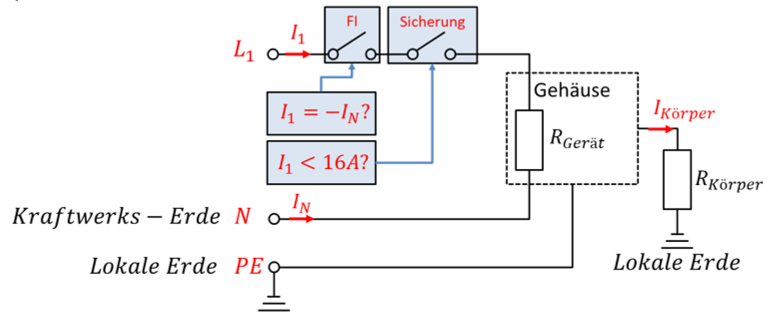
A further protection is that the protective conductor is connected to the (conductive parts of the) housings of all electrical consumers. If there is a fault in the device, a line conductor voltage can be present at the housing. You touch the housing in everyday life. Without a protective device, a dangerous current then flows through the body.
The protective conductor provides a very small resistance between the housing and the local earth (PE) at the house connection. If you touch the housing, a parallel circuit forms for the current between your body and the protective conductor. Since the protective conductor has a much lower resistance than a human body, almost the entire current flows away through the protective conductor to local earth. Nothing happens to you, because IKörper is very small. That is why it is important that you always connect the green-yellow protective conductor to the housings of lamps.
Normally the fuse trips immediately as soon as the line conductor voltage is present at a housing. Then 230V is short-circuited through the protective conductor to local earth and a very high current flows.
There is additional protection against touching the line conductors directly. If, for example, you repair a socket without removing the fuse (which is not a good idea), you could directly touch a live line conductor. Then the current flowing through the body does not flow back through the blue return conductor. It flows through the body and then into the local earth. As a result, current is “missing” in the blue return conductor. The current flows to the socket through, for example, conductor 1, but it flows back through the protective conductor instead of the neutral conductor.
As soon as IL is not equal to -IN (line conductor current not equal to neutral conductor current), the residual current device (RCD) trips. A hairdryer falling into the bathtub or a toaster falling into the washing-up water also lead to a fault current via the local earth. The function of the RCD, which evaluates the sum of the currents, is explained in more detail on this page (in German). The RCD trips at a current of 30mA.