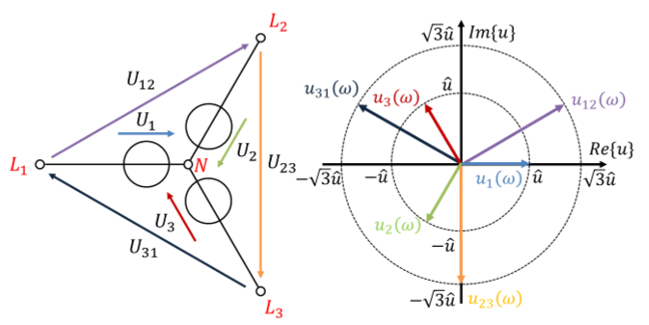
The RMS value of the voltage between an L conductor and the N conductor is 230V. The voltage between one L conductor and another L conductor can also be used. This voltage is called the “line-to-line voltage” or delta voltage UΔ. The line-to-line voltage U12, for example, is present between conductors 1 and 2.
In power engineering, the line-to-line voltage is much more important than the socket voltage. If a voltage is given without further information, it is always the line-to-line voltage. In the low-voltage grid of the sockets, its magnitude is about 400V. The delta voltage is determined from mesh loops. Here is the derivation:
The delta voltages between the L conductors are larger by a factor of root (3) than the star voltages between the L conductors and the N conductor. They have different phase angles. But they are again rotated by 120° relative to one another.
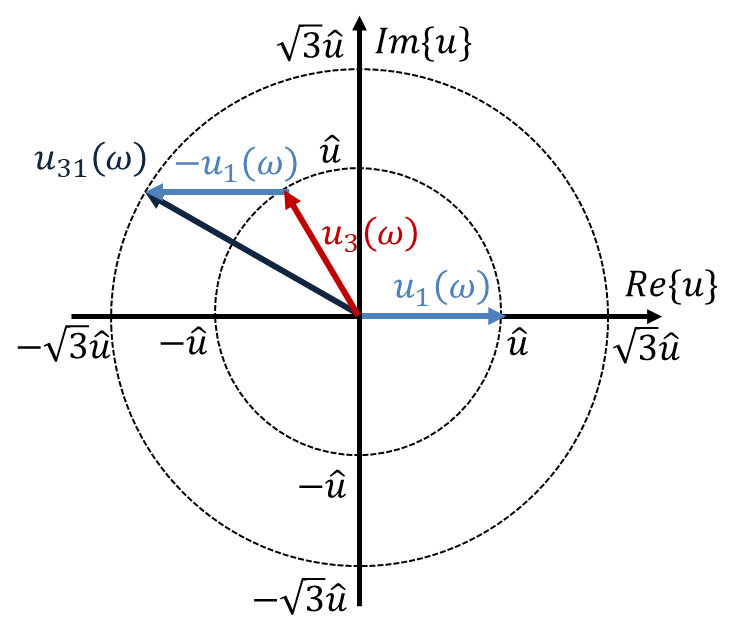
You can also work out the lengths and phase angles of the delta voltages by graphically adding or subtracting the star voltages in the phasor diagram. For u31 you have to calculate u3 – u1. A minus sign rotates by 180°; it always simply reverses the direction of the arrow. So you reverse u1 and then add the arrows:
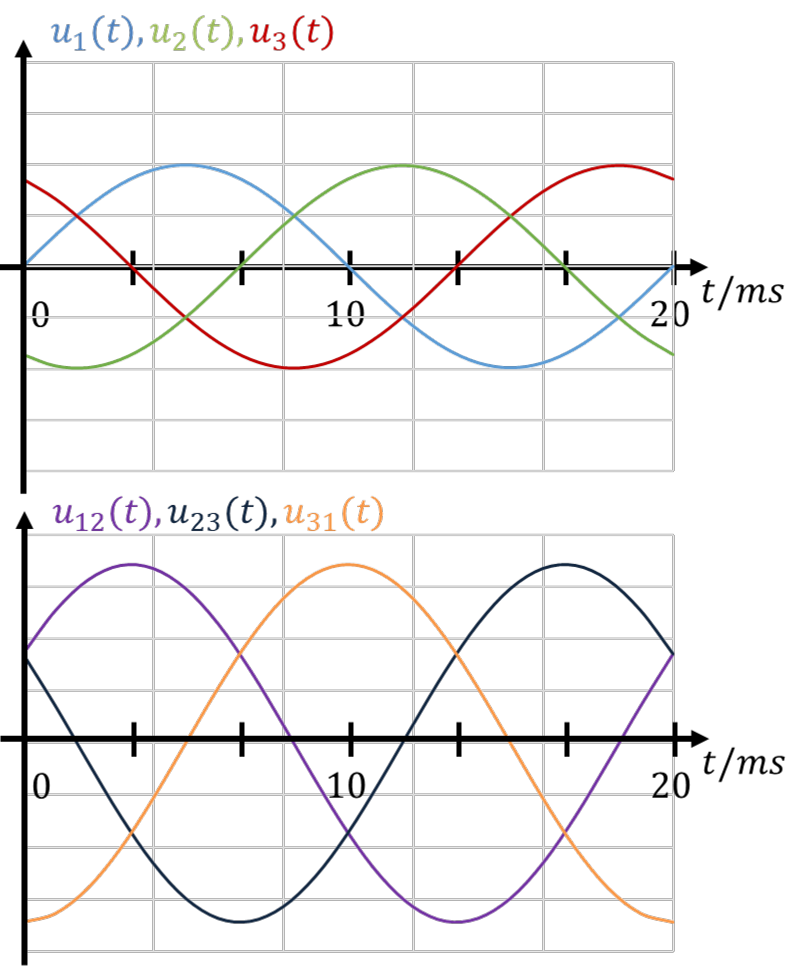
In the time domain, the waveforms look like this:
For calculations in practice, the RMS phasors of the voltages are of particular interest. They combine the RMS value with the phase angle. For the low-voltage grid with |U| = 400V:
Since no further information about the voltage has been given, the specification U = 400V always refers to the magnitude of the RMS phasor of the line-to-line voltage.