Force in an Electric Field
The following applies to fields in general: a field acts when there is a field cause or source. In electrostatics, a single unbalanced charge in space is already such a source. A force acts only when there is an object on which the source acts. The Earth has a gravitational field that attracts all masses. A force results from the field only when an object is attracted. So, in addition to the source, we need a further object on which the field acts in order to have a force. The second object must therefore be of the same type as the source. The Earth, as a huge mass, attracts other masses. Separated charge in space attracts or repels other separated charge.
The charge Q1 causes an electric field E1. The electrostatic force of this field acts on a second charge Q2 as follows:
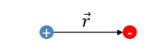
The distance between the charges is again given by the letter r. The intensity of the force – i.e. the magnitude of the force vector – is the same for all charges Q2 at distance r. For the direction of the force to be mathematically correct as well, the arrow of the vector r must point in the direction in which the force acts. So it must indicate the direction of the force on a positive test charge.
The distance r appears as a vector in the numerator. The magnitude of the distance appears to the third power in the denominator. If we are only interested in the intensity of the field or of the force, we need the magnitude of the respective vector. Then we can cancel the distance once. The following applies:
The charges Q1 and Q2 indicate how much charge has been separated in each case. If charges of different sign are present at the points, the charges cancel each other out. Then this charge does not count as separated. Q1 and Q2 therefore indicate the excess of charge at the two points in space (link to charge).
So far we have pretended that only Q1 generates a field and that the force acts only on Q2. Of course, all of this also applies the other way round. Q2 has a field E2 that acts on the charge Q1. In practice we also do not have just 2 charges but an extremely large number of charges. Charges on bodies are also not always point-like. But point charges are a good way of showing the basic effect of electric fields.
Superposition
When several charges are distributed in space, the forces are superimposed. Let us look at the three charges Q1 to Q3. If we want to calculate the total force acting on Q3, we proceed as follows: In the first step we calculate the force of Q1 on Q3. For this we need the distance between the two charges, which we obtain from the position vectors of the charges. We obtain the direction from the consideration that two positive charges repel each other. We completely ignore Q2 while doing this. Then, in the second step, we ignore the charge Q1. We calculate the force that Q2 exerts on Q3. In the third step we add the individual results.
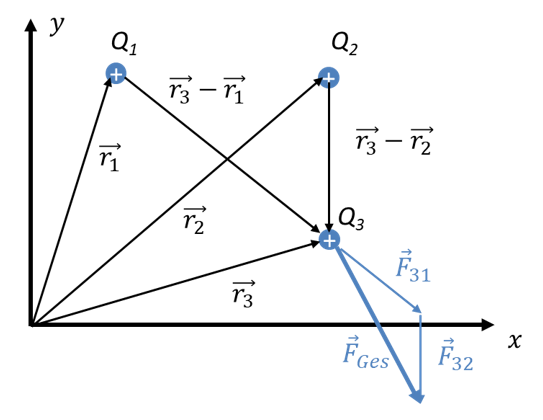
In this way we can determine, for every point in space, in which direction the field points when several charges are distributed in space. For two points in space with the same and with opposite signs, this gives characteristic field patterns, which can be seen at the following link (in German).
We consider two charges in space that are equal in magnitude but have opposite signs. The field between a positive and a negative charge in space looks like this:
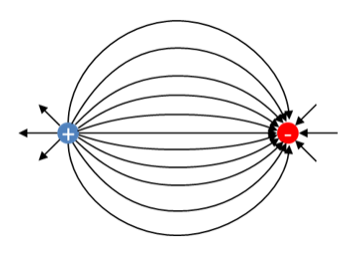
The field lines point away from the positive charge and towards the negative charge. To understand the course of the field lines, we consider a positive test charge that is added at some point in space. The direction of the force on this test charge gives the direction of the field line at the point where the charge is located.
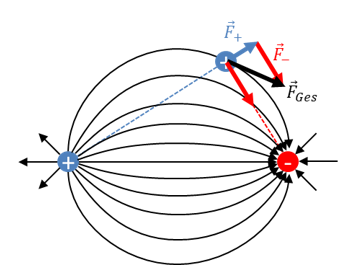
At the chosen point, the distance of the test charge from the positive charge is greater than from the negative charge. That is why the repulsive force (blue arrow) is shorter than the attractive force (red arrow). The resulting force (thick black arrow) is the tangent to the field line. It gives the direction of the field at the point where the blue test charge is located.
Example
The charge Q1=1 nC is located at point P1. The charge Q2=2 nC is located at point P2. Both charges are positive, so they repel each other. Between the points there is air with εr = 1.
Questions: a) What are the intensity and direction of the electric field generated by Q1? b) What force acts on charge Q2?
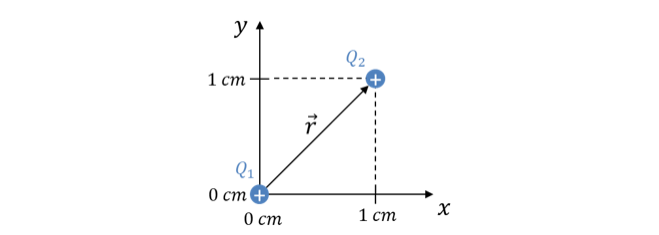
For calculating the direction it is important that a direction vector must always have length 1. The following applies
The vector pointing to the top right is too long. That is why the vector must be divided by its length so that it becomes a direction vector.