Disturbance Rejection by Storage Elements
Let us first consider storage elements in a system without a disturbance. Then:
Let us first consider an A that shows only P behaviour with KPR = 1. If there were no control error, e would be 0 and therefore y would always be 0. But we want y = w. How, then, can the control error vanish completely, intuitively speaking, as soon as we use a storage element in A? The answer lies in the time-domain equation of storage elements. If we use an A with pure I behaviour and KI = 1, we obtain:
So the value of y(t) depends not only on the current value of e(t), but on its entire past course. The parameter y0 contains the complete history of the control error over time. It is therefore not necessary for the control error e to be non-zero all the time; it is sufficient that it was non-zero at some point in the past. With e = 0, the equation above gives
A storage element keeps its output y constant when the input e = 0. The water level in a bucket stays constant when there is no inflow. So a bucket shows a non-zero level at its output y while its input e = 0. If the bucket is to be filled to the setpoint level ySoll (setpoint) = “half full”, an inflow e runs in until y = ySoll. After that nothing flows in any more (e = 0), and the bucket keeps its output state constant. In the model we consider a bucket as a system with KIS = 1/A (area A) and a P controller with KPR = 1:
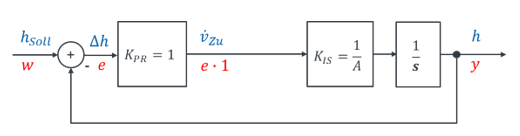
(Index Zu: inflow, Ab: outflow.)
Now let us consider a bucket with an outflow acting as disturbance d. When water flows out of the bucket, the level y drops. To compensate for this, an inflow e is needed that is exactly as large as d. This requires e = d ≠ 0, and we have a control error e again. Whenever we need a control error e to compensate for a disturbance d, we no longer reach the goal y = w. The storage element in A does not help to obtain e = 0 whenever the disturbance is integrated together with the control error, i.e. whenever the disturbance acts to the left of the integral in the block diagram.
Let us look at the formula for the level as a function of inflow and outflow:
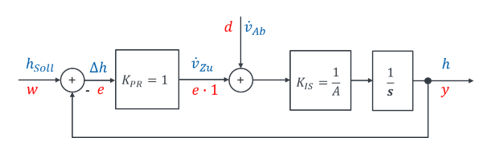
The formula only leads to a constant value y(t) = y0 if e(t) = d(t). As soon as the disturbance no longer acts (d = 0), the problem disappears, because then e = 0 holds again.