Magnetic Field Strength
Magnetic fields are described mathematically by several quantities. The electric current first causes a magnetic field strength H. It is comparable to the electric field strength E. The general formula is:
| Physical quantity | Symbol | Unit name | Unit symbol |
|---|---|---|---|
| Magnetic field strength | \(H\) | ampere per metre | \(\dfrac{\mathrm{A}}{\mathrm{m}}\) |
The “closed line integral” of H over the path ds equals the current that causes the field. The closed line integral is applied to whatever geometry you shape the current-carrying conductor into for your application. If the wire is straight and long, the integral dissolves pleasingly into the following special formula:
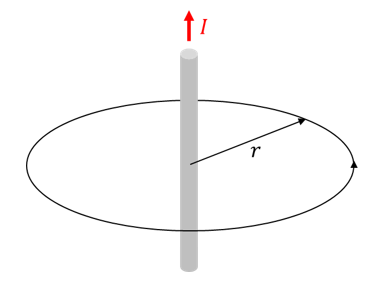
The intensity of the H field decreases with the distance r from the wire. Important: this is a special formula that applies only to long straight wires. Other formulas apply in other geometries.
Explanation of the closed line integral
Intuitively, the closed line integral says the following: in our minds, we stand on a field line of the H field and walk once round in a circle along the field line. On the way, we add up the intensity of the H field. At the end we arrive back at the starting point. In doing so, we have integrated
once. H always equals the intensity of the field at the place in space where you currently are. The term ds describes the distance you have covered. So if you walk along a circular field line, you walk around the circumference of the circle with radius r. The following then applies:
The intensity of the H field is the same everywhere on the circumference U = 2πr, because the distance r to the conductor is the same everywhere here. If you choose a field line for the integration that runs very close to the wire, the radius of the circle and thus the path ds are small. For a fixed current I, the H field is then large. For a field line far away with the same current I in the wire, the radius and path ds are larger. Then the H field must be smaller. This is how mathematics describes the field becoming less and less intense with increasing distance from the wire.
Superposition of several currents as sources
The magnetic fields of n currents through n conductors are superimposed. To calculate how high the magnetic field strength is at a place in space, the distances ri of the conductors from this place in space must first be determined. Then we also need the intensities of the currents. We calculate the fields of the individual conductors at this place one after the other and add the partial results vectorially at the end. This works as in electrostatics when calculating the electric field of several point charges.
There is a simpler way of calculating, which is why I do not go into superposition in more detail:
If several currents pass through an integration path of the closed line integral, they all act in the closed line integral. The sign of the current depends on the current direction. With the help of the “right-hand rule” you can determine which current acts positively. We now leave behind the idea of field lines running in circles around a conductor. These are mathematically simple because the same field strength H is present everywhere on them. You can also apply the closed line integral to arbitrary integration paths ds.
In the following example, the following applies for integration along the black line:
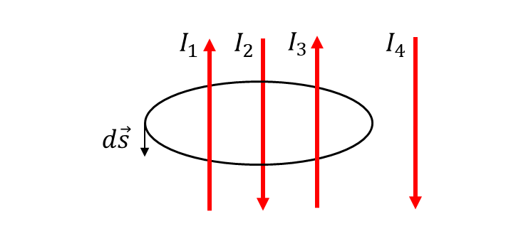
This relationship is called “Ampère’s circuital law”. The closed line integral along the black circle in the direction ds shown includes only the currents I1 to I3. I4 lies outside the integration path and therefore does not act in the closed line integral. According to the “right-hand rule”, I1 acts positively, because the fingers point in the direction of ds when the thumb points in the direction of I1.
For field calculation, this approach is often simpler than applying superposition. Later we will fix the integration path of the closed line integral. The intensity of H will be constant along this integration path. Then, for an integration along the length l:
Caution: this is not a general formula, but the goal for a simplified field calculation that does without solving the closed line integral.
Summary
An electric current causes a magnetic field strength H. It acts similarly to the electric field strength E. It depends on the distance from the field source, i.e. on the distance from the current-carrying conductor. To calculate the intensity of the magnetic field strength, we use the formula with the closed line integral. The fields of several currents are superimposed. That is why we use the following general formula for field calculation:
For electrically generated magnetic fields (“electromagnets”) we need electric current. The magnetic field of a permanent magnet is also generated by moving charge, at the atomic level. The Earth’s magnetic field is also generated by moving charge. So the effect of the field source is always the same for every magnetic field.