Inductance
The inductance L of an inductor depends on the number of turns N, on the inductor geometry and above all on parameters of the inductor core. The following applies
\[
\begin{gathered}
L = \mu_0 \mu_r \cdot N^2 \cdot \frac{A_{\mathrm{Kern}}}{l_{\mathrm{Kern}}} \\[6pt]
L\text{: inductance} \\[6pt]
\mu_0 = 4\pi \cdot 10^{-7}\,\frac{\mathrm{Vs}}{\mathrm{Am}}\text{: natural constant} \\[6pt]
\mu_r\text{: material parameter} \\[6pt]
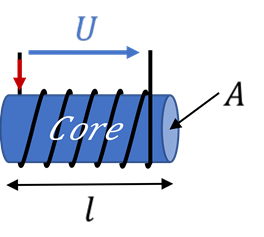
N\text{: number of turns (fig.: } N = 6\text{)} \\[6pt]
A\text{: cross-sectional area of the core} \\[6pt]
l\text{: length of the core} \\[6pt]
u_L(t) = L \cdot \frac{di_L(t)}{dt} \\[6pt]
i_L(t) = \frac{1}{L} \int u_L(t)\,dt \\[6pt]
U_L(\omega) = j\omega L \cdot I_L(\omega) \\[6pt]
\text{Impedance: } Z_L = j\omega L
\end{gathered}
\]
The parameters A, l, N and µ0 are fixed. With highly optimised cores, the material parameter µr varies very strongly between specimens from the same production batch. Above a cut-off frequency, µr decreases with the frequency f of the current, because the elementary magnets cannot rotate arbitrarily fast. In addition, the value of µr depends on the instantaneous value of the current. We do not go into this any further here.