Capacitor
A capacitor is a store for electrical energy. It stores energy in the form of separated charges. A reservoir always keeps enough water in stock for the hydroelectric power plant. The capacitor keeps separated charges in stock, which can flow from there into a circuit in the form of current. If a load needs a lot of power for a short time, it can be taken from the capacitor.
In a circuit, a capacitor behaves similarly to a source. The difference is that the charge that has been taken out must also be refilled by the circuit. In use, the capacitor can also be emptied completely. It just cannot be filled beyond its maximum.
In its simplest form, a capacitor consists of two parallel metal plates that do not touch each other and between which there is an electrically non-conductive material (e.g. air). When separated charge is stored in the capacitor, there are many positive charges on one plate and few on the other (conventional current direction). Each plate is connected to a terminal with which the capacitor is connected to the other components of the circuit. A voltage can be measured between the plates as soon as charges are separated on them.
The capacitance C of a capacitor describes its storage capacity for charges. Like the volume of the bucket, it indicates how much separated charge can be stored in the capacitor at most. The following applies

| Physical quantity | Symbol | Unit name | Unit symbol | Circuit symbol |
|---|---|---|---|---|
| Capacitance | \(C\) | Farad | \(1\,\mathrm{F} = \mathrm{s}/\Omega\) |  |
The capacitance C is given in the unit farad. The capacitance is determined by the geometry of the construction and a material parameter. If the area increases, the capacitance also increases, because more charge fits on the surface of the plates. If the distance d decreases, the capacitance also increases.
Optimising the capacitance
Note: this section up to the next heading is not relevant for the exam.
Thousands of capacitors are installed in a smartphone. For the smartphone to fit into a trouser pocket, all components in it must have very small dimensions. Nevertheless, capacitors with a large capacitance are needed, e.g. to provide energy briefly for sending a message.
So we need capacitors with a large capacitance and a small area A. To achieve this, we make the distance d as small as possible. The smaller the distance d between the plates, the smaller the maximum voltage of the capacitor. Let us bring separated charges extremely close together and keep increasing the voltage. Then, above a certain voltage, the charges “break through” the insulator between the plates, even though the insulator does not actually conduct current. They form a conductive tunnel through the insulator. The capacitor is then defective, and usually the circuit too. So we cannot make the plate distance d arbitrarily small.
In capacitors, we use insulation material with the largest possible material parameter εr. The maximum voltage at a very small distance d also depends on the insulation material. When the media report on raw materials from conflict regions that are needed to manufacture smartphones, they are referring, among other things, to this filling material of capacitors. A technically well-suited material is tantalum, for example: its oxide (tantalum pentoxide) has a high εr and can be produced as a very thin layer. We cannot change the natural constant ε0.
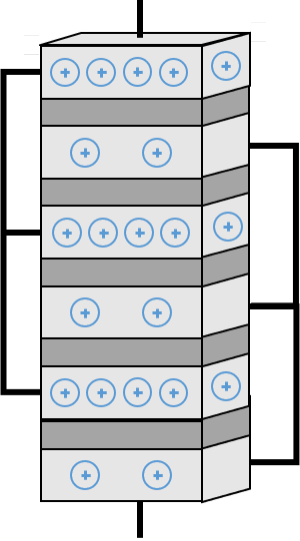
We can optimise the capacitance further through the construction of the capacitors. To do this, we do not just stack 2 plates on top of each other, but very many plates. There is an insulator between each pair of plates. Every second plate is connected to the others, so that the largest possible area A is formed.
The capacitance C determines the relationship between charge Q and voltage U according to the following formula:
It is easy to separate a lot of charge if a lot of voltage is available for it. A “good” capacitor with a high capacitance can keep a lot of charge separated with little voltage. This is particularly important in battery-powered systems that have to manage with little voltage. If charge Q is taken from a capacitor, its voltage U drops. It drops less, the larger the capacitance C.
Analogy to the water bucket
Note: this section up to the next heading is not relevant for the exam.
Let us look at the model of the water bucket from the last chapter. There is an analogy between the water bucket and the capacitor.
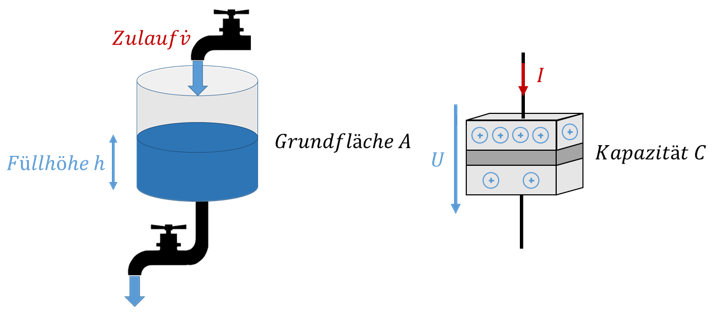
For the bucket, we defined the inflow or outflow as the input quantity. The output quantity is the fill level h. For the capacitor, the electric current is the input quantity. It describes the inflow rate of the charge Q. The output quantity is the voltage U.
The capacitance C of the capacitor corresponds to the base area A of the bucket. The fill level h corresponds to the voltage U. The amount of water in the bucket corresponds to the charge Q separated in the capacitor.
If water is taken from the bucket, the fill level h drops. If separated charge Q is taken from the capacitor, the voltage U drops. The larger the base area A of the bucket, the less the fill level h drops when water flows out. The larger the capacitance C of the capacitor, the less the voltage U drops when separated charge flows out. The maximum amount of water is limited by the bucket volume V = A ∙ hMax. The maximum amount of charge QMax is limited by the capacitance C multiplied by the maximum voltage UMax.
The water from the bucket, which serves as a water store, is now to drive a water wheel. For this, the bucket first gets an inflow from above and an outflow at the bottom:
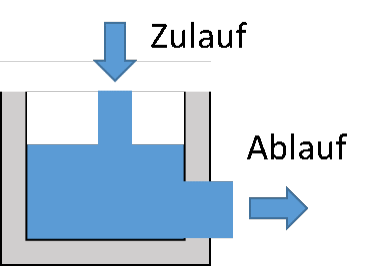
There is a supply pipe with which the water wheel is driven. The problem is that most of the time the water wheel receives more water than it needs. In short intervals, however, much more water is needed than the supply provides.
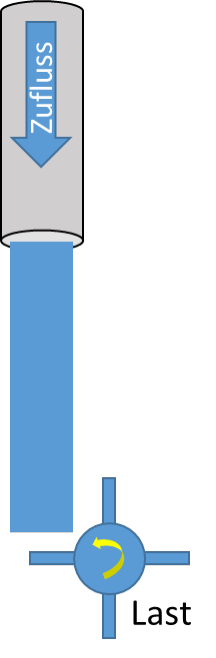
As a solution, part of the water is diverted into the store. If required, the store can provide additional water. A valve controls the outlet of the store. The store is filled with the surplus water.
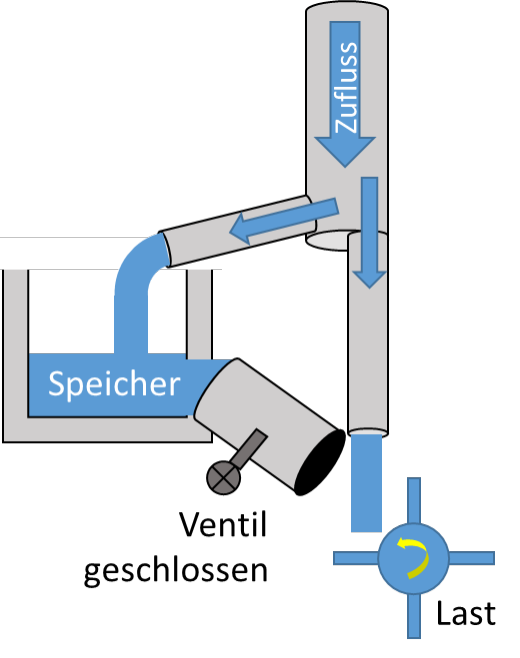
Now less water arrives continuously at the load. The remaining water is stored in the store. The fill level of the store rises continuously as long as the outlet valve is closed. If the load briefly needs more water than the supply can deliver, the outlet valve is opened.
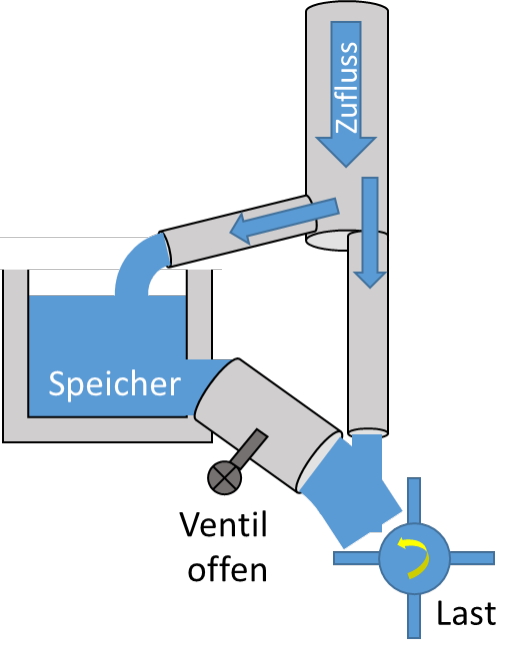
The store empties. The load briefly receives more power.
Negative voltage
The analogy is limited. The bucket cannot be filled negatively. Less than empty is not possible. A capacitor, however, can be charged with a negative voltage. To do this, the excess charge is simply placed on the lower plate instead of the upper plate.
Let us look at an uncharged capacitor. Both plates are charged equally. Now a positive current flows into the upper terminal of the capacitor. Current always flows in a loop. Current is not lost in a component, so it flows out of the capacitor again at the bottom. In this way, the upper plate is charged and the lower plate is discharged. The voltage across the capacitor is thus positive. This case is shown in the top one of the following three figures.
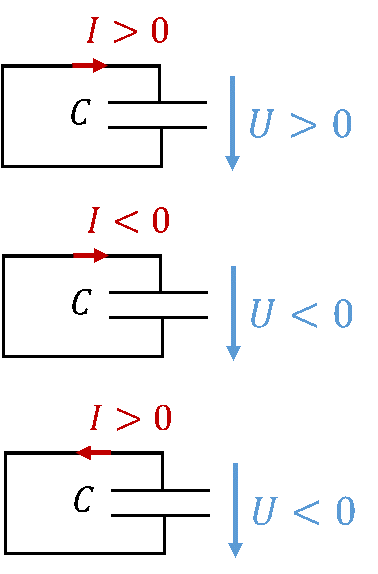
Let us look again at an uncharged capacitor. Both plates are charged equally. Now a negative current flows into the upper terminal of the capacitor. It flows out of the capacitor again at the bottom. In this way, the upper plate is discharged and the lower plate is charged. The voltage across the capacitor is thus negative. This is shown in the middle figure.
You can think of a negative current as a positive current in the other direction. So turn the current arrow of the middle figure around and take a positive current. This case is shown in the bottom figure. It only serves to illustrate a negative current direction; it does not show a new relationship.
Relationship between voltage and current
In the chapter Calculating with energy stores, it was shown that the fill level of a bucket is determined by the integral of the inflow or outflow. For the bucket and the capacitor, the following applies:
If a current flows into the capacitor, the voltage rises. So with the help of a current, additional charge is separated at the capacitor, and the energy in the capacitor increases. If a current flows out of the capacitor, its voltage and its energy decrease. Since the current flow is the cause of the voltage across the capacitor, for the first electrical consideration I use a current source that changes the voltage UC across the capacitor with the current IC. Let us look at a numerical example:

First, we note that the current is constant over time during the charging process. This simplifies the calculation. The following simplification only applies to currents that are constant over time. If the current changes over the integration time, you must find the antiderivative for the integral. For a constant current, the following applies:
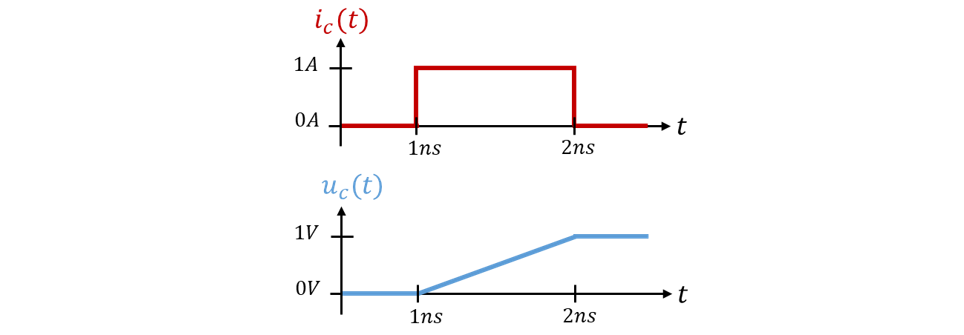
After filling, the voltage across the capacitor is UC = 1 V. If current flows into or out of the capacitor again, the voltage changes again. So afterwards, let the current i = −1 µA flow out of the capacitor for Δt = 1 ms. The change in current direction leads mathematically to a change of sign in the formula. Because the current is again constant during the integration time, the following applies:

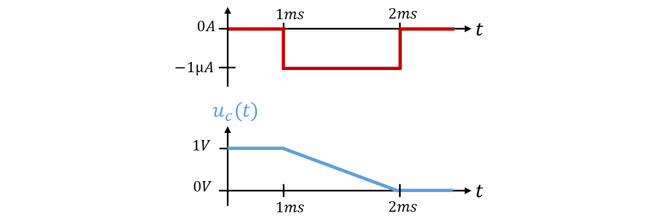
The inverse function of the integral is the derivative. If the voltage across the capacitor is given and the current is required, the voltage equation is transformed by differentiating both sides as follows:
Power and energy
For the power, let us first look at the water model: the mechanical power delivered by the water from the store to the load is proportional to the amount of water per unit of time multiplied by the height from which the water falls onto the paddle wheel. The lower the fill level of the store, the less power it can deliver, because the water then arrives at the load with less pressure. A good store therefore has such a large base area that the fill height changes only slightly while it is being drained.
Power is defined as the product of voltage and current. At the capacitor, there is power when both voltage and current are present at the same time. This is only the case during a charging process and during a discharging process.
Next, let us look at the energy that a capacitor can store. The following applies
So the energy stored in the capacitor depends on the square of the voltage U and linearly on the capacitance C. The more voltage is applied to a capacitor, the more energy is stored in it.