Resonance
Perhaps you have pushed a child on a swing at some point. Or you have sat on a swing yourself. You will have noticed that the frequency of the swing’s oscillation does not change, whatever you do. You can push as hard as you like, you can give the swing a violent impulse … the swing always oscillates at the same frequency. You only change the height of the end position, i.e. the peak value.
Every system capable of oscillation has a “resonant frequency” at which it can oscillate. You can change the resonant frequency of the swing by design, by changing the length of the swing’s ropes. With longer ropes, the oscillation frequency decreases. Once the swing has been hung, however, you can no longer change it. Nor does it depend on the weight on the swing.
The resonant frequency of a system follows from the physical equations. For this, we set up the differential equation of the motion. So far we have worked with the directions x and y to describe both forms of energy. Now, with a mathematical trick, we express both forms of energy as functions of x only and set them equal. To do this, we consider the deflected pendulum as a triangle.
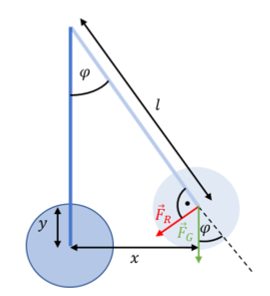
One component of the gravitational force FG keeps the pendulum string taut. It acts along the string, down to the right. Another component of the gravitational force is the restoring force FR. It acts in the direction of the pendulum’s motion. The sign of the force is negative, because it acts in the −x direction. We can calculate this force from the pendulum mass m, the gravitational acceleration g, the deflection x and the string length l.
For the force of a motion:
Here we again simplify by assuming that the motion only takes place in the x direction. So the calculation only applies to pendulums that are deflected by so little x relative to the string length l that the y component of the motion can be neglected.
We now set the forces equal. The following applies:
Only motions that satisfy the bottom equation can exist. The equation applies when no energy is supplied or removed from outside. To check whether the pendulum can perform a certain type of motion “by itself”, we insert the mathematical description of the motion into this equation. If there is a solution of the equation with this form of motion, the motion is possible.
The equation is satisfied for x(t) = 0. That is the pendulum at rest. This operating point is mathematically correct, but not helpful for assessing an oscillation.
Digression: we can also try other types of motion, e.g. a linear motion.
For a linear motion, the equation is only satisfied at all times t if m = 0 and b = 0, i.e. x(t) = 0. That is standstill. So there can be no linear motion of a pendulum, because a motion needs x-values other than 0.
With this digression I just wanted to show you which motion is not possible. If you do not understand it yet, that is not a problem. The next section follows with a physically possible motion. Comparing the motion functions should make clear which one is possible and why.
Let us try something else: we already know that the motion in the x direction is sinusoidal. So we insert a sine and see whether the equation is satisfied. To stay compatible with the literature, I insert a cosine instead of a sine. That only changes the phase. We now release the pendulum at an end position. So we start with a maximum positive value of x and have a cosine-shaped motion.
We can cancel the term x(t), which makes the equation simpler:
For a motion, both sides of the equation must be equal. The term x(t) appears on both sides of the equation. These terms x(t) are already equal on both sides. The remaining terms give a requirement for ω. For a motion with x(t) = cos(ωt), the equation forces a fixed value on ω – the resonant frequency.
The equation has a solution for all x if we insert a sine or cosine as the form of motion. So a sinusoidal motion of a pendulum is possible with any (small) peak value. Let us compare this solution with the linear motion: there, the equation of motion only had the solution x = 0. That is the starting point of the linear motion and corresponds to remaining at rest. So the pendulum can only either oscillate sinusoidally or remain at rest.
The pendulum always oscillates sinusoidally at the resonant frequency, which is determined by the gravitational acceleration and the string length. At any other angular frequency, the equation of motion is not satisfied. So the pendulum can only ever oscillate at the same frequency. This also agrees with practical experience with pendulums.
As soon as external forces are added, the pendulum can perform any other form of motion. If, for example, you stop or push the pendulum by hand, the equation of motion, which was set up only for two internal forces, no longer applies.
Interestingly, the resonant frequency at which the pendulum oscillates depends only on the string length (and the gravitational acceleration), and not, for instance, on the weight. We can only recognise this once we have set up the force equation from physics. For every system capable of oscillation there are other equations of motion or system equations that represent the physics of the systems. Most are not as simple as that of the pendulum, which is why I do not consider them further here.