Charge
It is known from physics that electrons are negatively charged and protons positively charged. Each carries the elementary charge. Negatively charged electrons orbit the atomic nucleus, in which positively charged protons are located. Within an atom, there are different charges at different places. Many protons create a lot of positive charge in total. Many electrons at one place charge it more negatively than if only a few electrons were there. The following schematic diagram illustrates the structure of an atom with regard to charge:
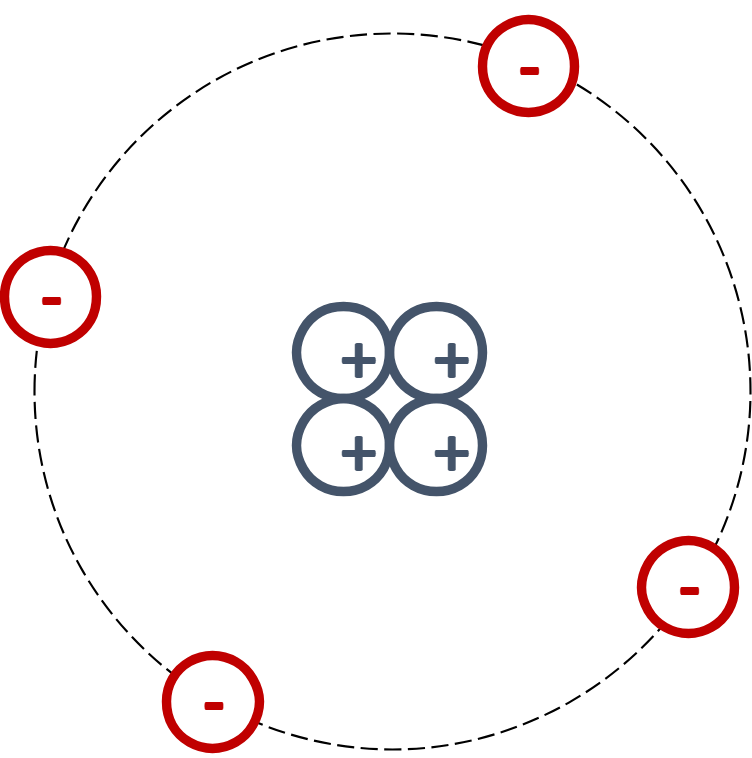
There are only multiples of the elementary charge e, never fractions of it. So charge cannot be divided arbitrarily. It is bound to the constituents of an atom. A charge is always given in its unit C (coulomb). One coulomb corresponds to one ampere-second.
| Physical quantity | Symbol | Unit name | Unit symbol |
|---|---|---|---|
| Charge | \(Q\) | coulomb | \(1\,\mathrm{C} = 1\,\mathrm{A} \cdot \mathrm{s}\) |
The table above defines the first unit of electrical engineering. From it you need the name charge, the symbol Q, and the name and symbol of the unit, C or coulomb. If you state the charge of an electron, you do it like this:
The numerical value corresponds to the elementary charge of a proton or electron. Because of the negative sign, this is evidently an electron. Atoms and molecules consist of electrons and protons. They have states of charge based on a deficiency or an excess of electrons. There are also electrically neutral bodies containing the same number of positively charged protons and negatively charged electrons. Then there are electrically positively and electrically negatively charged bodies.
Similar to the way a magnet attracts a piece of iron, attractive and repulsive forces also act on charges.
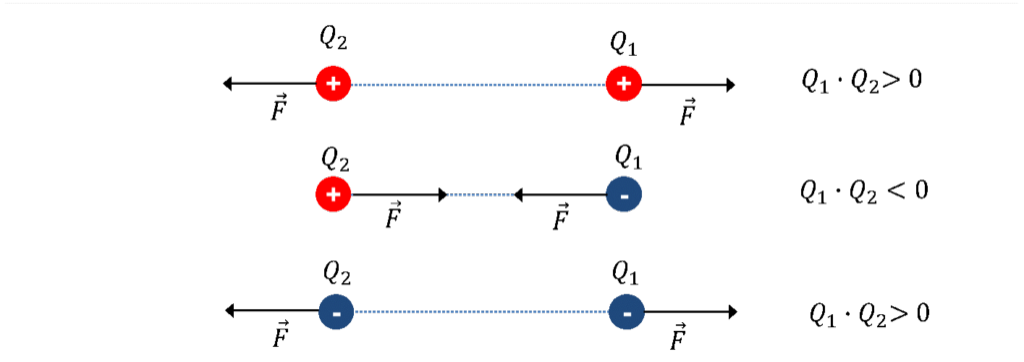
A positive charge attracts a negative charge. It repels another positive charge. A negative charge attracts a positive charge and repels another negative charge. Attraction and repulsion take place constantly in a body full of electrons and protons, because every charge acts on all other charges in its surroundings.
Like charges (− and − or + and +) repel each other; unlike charges attract each other. The direction of the force can be determined mathematically by forming the product of the charges. If the product is positive, the charges are alike, so they repel each other. If the product is negative, a positive and a negative charge are involved, and these charges attract each other.
In solids, protons are fixed in place, i.e. immobile (at the atomic level). Electrons are mobile; their movement can be controlled technically. That is why we concentrate on electrons, because we want to separate charges. To do this, we have to move them out of their original position.
Just as the potential energy of a body is increased when it is lifted, electrical energy is increased by bringing a previously balanced state of charge out of balance. As a model, let us consider two electrically neutral bodies in space.
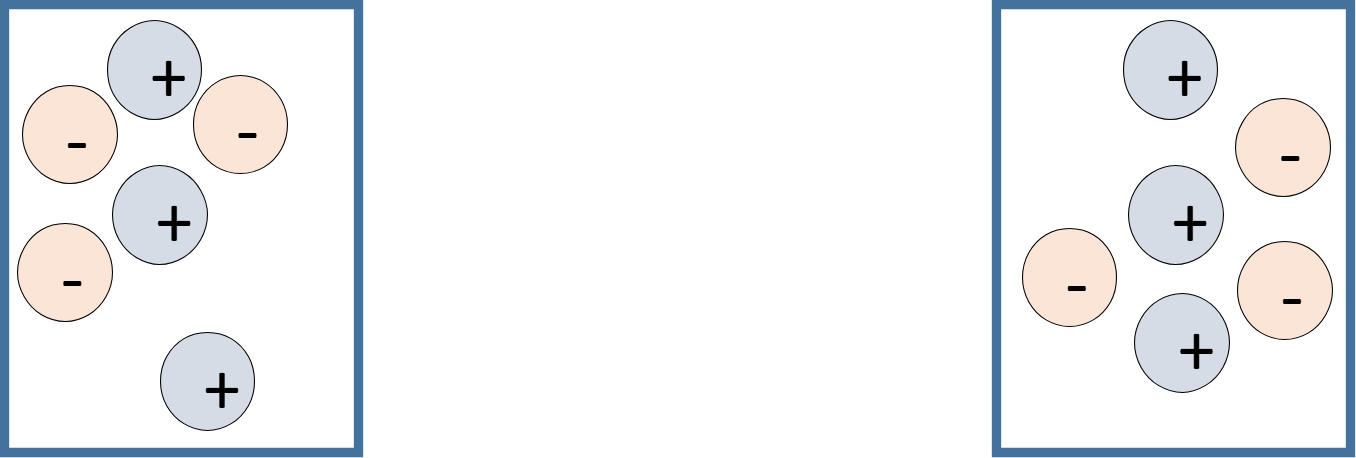
Both bodies are electrically neutral, because they have the same number of electrons and protons.
Now we carry out charge separation. An electron is removed from the right-hand body. It is moved to the left-hand body.
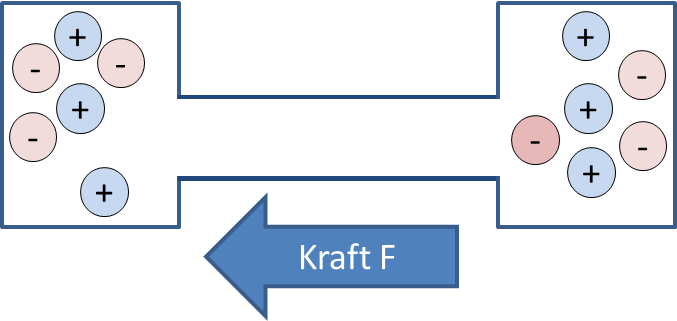
To separate charge (and thereby increase the energy state of both bodies), energy must be supplied to the system. A force F is required to move the charge and thus separate it. For the charge to travel from one body to the other, a path must be created between the bodies. Charge does not move through air, only through suitable materials.
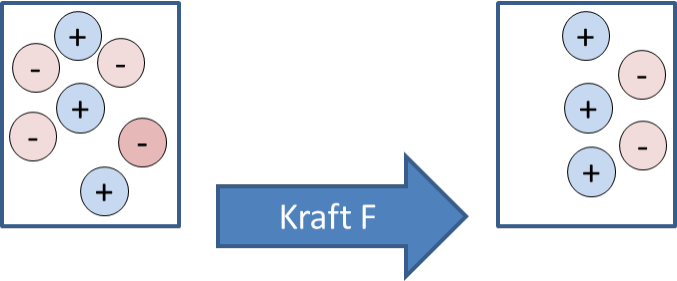
After the charge separation, the connecting path is removed again in the thought model. Now the left-hand body has one electron too many and the right-hand body one electron too few. The left-hand body is negatively charged, the right-hand one positively. An attractive force acts between the oppositely charged bodies. The new attractive force corresponds exactly to the force that was previously invested in the charge separation.
Put simply: the electron wants to go back. Physically speaking: every system strives for the state of lowest energy. A force always acts on movable parts in the direction in which the energy state of the system would be minimal after a movement.
As an analogy, consider a stone in a room that is lifted by a person. The gravitational force acts on the stone downwards (i.e. towards the centre of the Earth). The lowest achievable energy state of this stone with regard to its potential energy would be reached if the stone were lying on the floor of the room (or even further below, but that is not possible in the room). Then the energy would be minimal at the smallest possible height h.
If a path is created so that the stone can move (the person lets go of it), the gravitational force causes the stone to move towards the floor, because there it is in the state of lowest potential energy. The force for this downward movement is just as large as the force with which the stone was previously lifted.
In general: if we apply a force F to increase the energy in a system, exactly this force subsequently acts in the opposite direction to restore the old state. After a charge separation, the energy in the system is higher than before. So we need a force F to separate the charge in the first place. Afterwards, the same force F always acts on the separated charges in the direction that cancels the charge separation again.
In electrical engineering, we use these charge forces, for example, to drive an electric car. First we separate charge. Then we store the increased energy as separated charge, e.g. in a battery. Afterwards, you accelerate in the electric car, and the force of the charge separation accelerates your car.
Further sources (in German):
Leifi Physik: atomic physics,
initially relevant only up to figure 6.
Leifi Physik: charge
YouTube video 1
YouTube video 2
How to use the sources: if you like a source, look for content on other topics on these sites as well.