Series Resistor
With your knowledge of meshes and nodes, you can already solve some problems in electrical engineering. If, for example, you have a motor as a load that needs a voltage of UMotor = 3 V, but your voltage source outputs U0 = 5 V, you have to reduce the voltage of the source for the load by 2 V. To do this, you use a series resistor. Assume the motor needs a current of IMotor = 1 A.
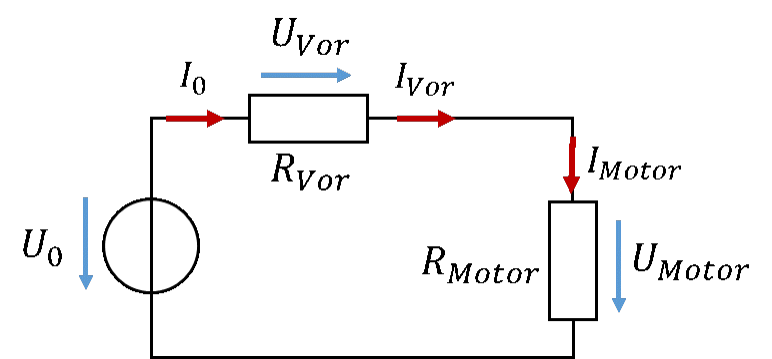
The series resistor is connected between the source and the load. We call the voltage across the series resistor UVor. The mesh equation applies:
This means that the voltage and current at the series resistor are known and it can be dimensioned. You must use the voltage and current present at the component. So do not take the source voltage or the motor voltage, but the voltage across the series resistor. The following applies: