Conductance and Conductivity
In the previous examples we always said that we create a path for the mobile charges between two bodies. This is done with connectors made of materials that conduct electric current well, so-called conductors. Electrical conductance describes the property of a connector or component to conduct electric current particularly well. If only a little voltage (force on the charge) between 2 points is enough to make a lot of current flow, the region between the points conducts well. The conductance G is defined as
The unit of conductance is composed of the unit of current A and the unit of voltage V. Since conductance is central to electrical engineering, it gets its own unit, the siemens (S).
| Physical quantity | Symbol | Unit name | Unit symbol |
|---|---|---|---|
| Conductance | \(G\) | siemens | \(1\,\mathrm{S} = 1\,\mathrm{A}/\mathrm{V}\) |
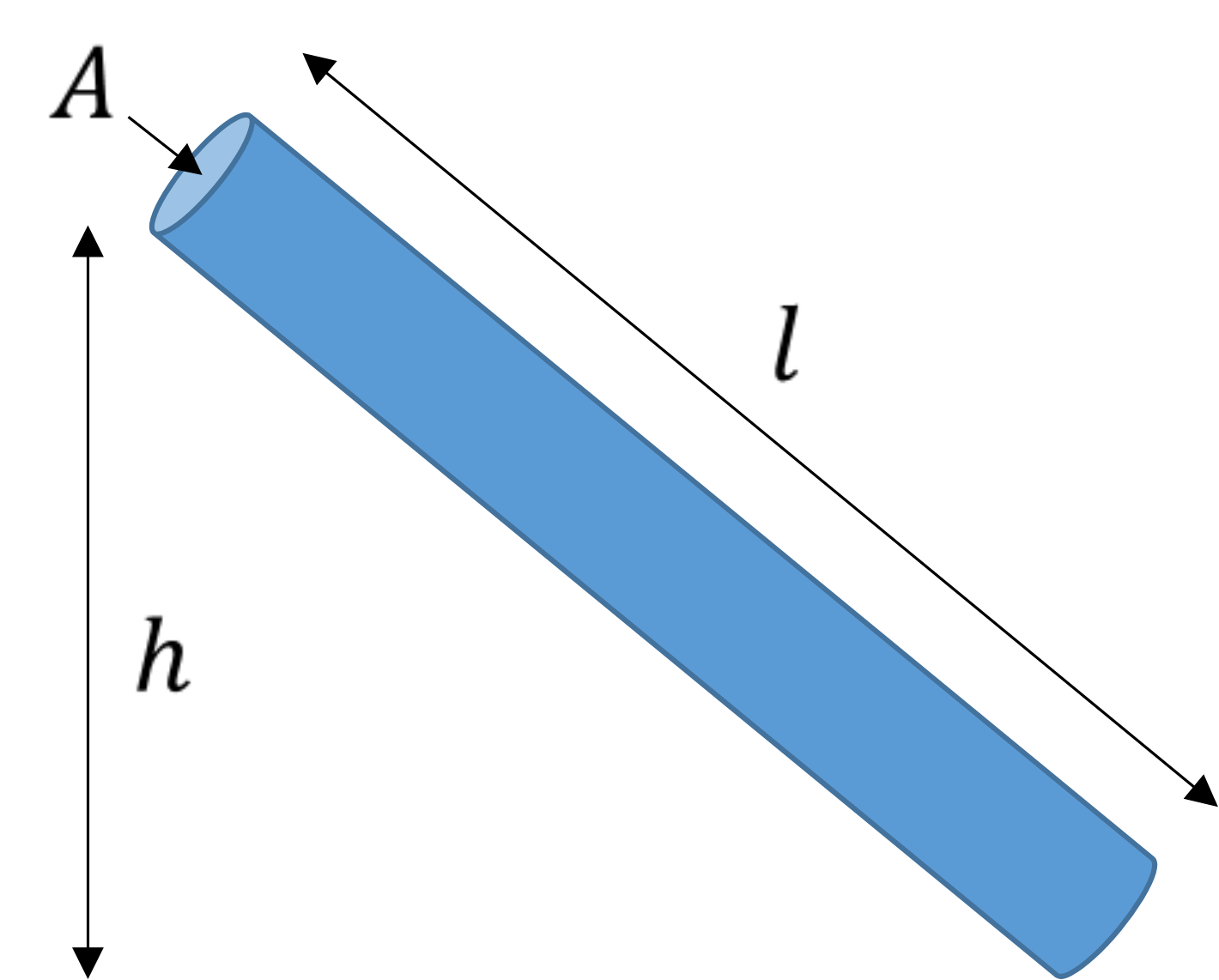
The conductance depends on material and geometry parameters. The following applies:
κ is a material parameter. Copper, for example, conducts better than plastic, so the following applies:
That is why cables are made of copper. Copper has good electrical conductivity and a relatively low price. This ensures that the current can flow easily through the cable. The conductive copper cores of a cable are sheathed with plastic, which conducts current extremely poorly. This prevents the current from flowing outside the cable.
Most connectors between components are wires or cables. On printed circuit boards you will find copper traces lying flat on the substrate. A cylindrical copper wire has a cross-sectional area, a length and a conductivity.
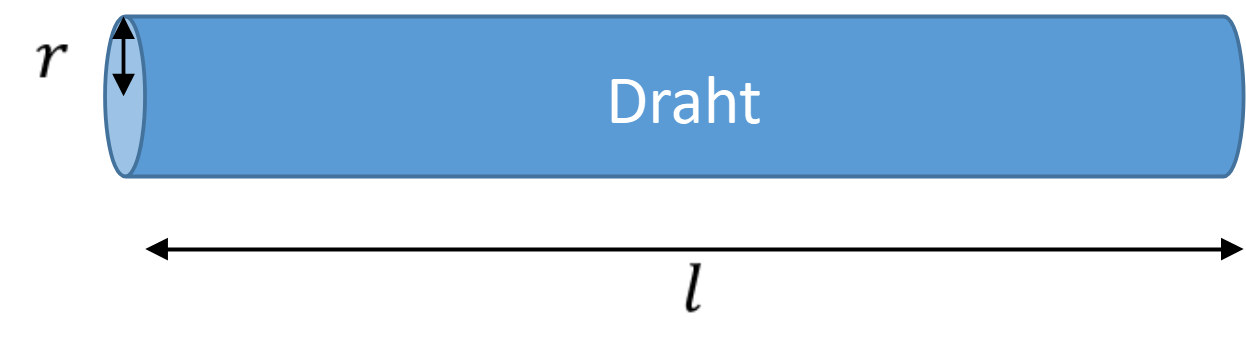
The values of the material-specific conductivity κ can be taken from tables. κ has the unit Sm/mm2. Sometimes you will also come across values in µS/m. For calculating a conductance, it makes sense to give the area A directly in the unit in which the conductivity is given. Then the units cancel without further prefixes. In the example above, the area should therefore best be given in mm2.
To connect a battery with an LED to make a torch, for example, we need two wires with the highest possible conductance. If the conductance is low, part of the battery voltage is already lost in the wire, because U = I/G applies to the wire. The current I that we need in the LED causes a voltage U in the wire. This voltage is greater the lower the conductance G of the wire. The wire should therefore be as short and thick as possible and made of highly conductive material.
Ohmic resistance
The ohmic resistance R is the reciprocal of the conductance G. It is named after Mr Ohm. Electrical engineering would also work with conductance alone, but resistance (I leave out the "ohmic" out of laziness) has become established as an additional quantity. The following applies:
Ohm's law is a central equation in electrical engineering. Because of U = R ∙ I, it is also called "URI" in German. What do we need resistance for? It describes how much resistance is opposed to a current flow when a voltage is applied. The greater the resistance, the smaller the current.
| Physical quantity | Symbol | Unit name | Unit symbol |
|---|---|---|---|
| Resistance | \(R\) | ohm | \(1\,\Omega = 1\,\mathrm{V}/\mathrm{A}\) |
The unit of resistance is the ohm (Ω). Like the conductance, the resistance depends on material and geometry according to
The conductivity κ can also be given as the resistivity ρ.
The term resistor
Every body has an ohmic resistance that results from its geometry and its material coefficient. So the word resistance denotes a property of every body.
In electrical circuits there is a component that is also called a "resistor". It has two terminals. It has an ohmic resistance (as a property) that limits the current in a circuit. Simple circuits can be built with resistors, because resistors can be used to control where and how much current flows in a circuit.
Analogy with the water model
The water model helps to understand the relationships between voltage, current and resistance. Let us imagine a lake on a mountain. From the lake, a river flows down the mountain into the sea.
The water on the mountain has the potential to flow to the sea. The water in the sea does not have the potential to flow up the mountain to the lake. The height of the water on the mountain is greater than in the sea. So is the potential of the water to flow down. The height of the water is analogous to the electric potential of a body. The difference in height between mountain and sea drives the water. The potential difference between two bodies corresponds to the voltage. The difference in height is therefore analogous to the electric voltage.
The greater the difference in height between mountain and sea, the faster the river flows. The flow rate of the water is analogous to the electric current. The higher the voltage between two bodies, the greater the electric current. Just as the voltage is proportional to the force on mobile charges, the difference in height is the cause of the force on the water.
The flow rate of the river can be influenced by the riverbed. The narrower the path for the water, the less water flows in the river per unit of time. The narrowness describes the available cross-sectional area A of the riverbed. The longer the path l of the water between source and mouth, the more slowly the water flows, because over the length a difference in height becomes a gradient.
But a resistance to the flow of water can also be defined. With a large resistance, the water flows more slowly. If there is dense vegetation in the river, so that lianas and leaves grow everywhere in the river up to its surface, the water cannot flow as fast, because the plants slow the water down. The amount of vegetation ρ is a kind of material parameter that leads to a reduction of the flow rate per difference in height. For this water resistance, the following applies:
The resistance of a wire, for example, is analogous to the riverbed. The higher the resistance, the smaller the current for the same voltage. The resistance increases with the length of the wire and the material parameter, and it decreases with the cross-sectional area of the wire.
The water model is now extended by tanks and pipes. The difference in height between two tanks corresponds to the voltage. The diameter and length of a pipe between the tanks define the resistance. A change in the amount of water per unit of time between the tanks then arises according to Ohm's law: