System Modeling
A system generally consists of several function blocks. System modelling abstracts a system into the interconnection of the function blocks in a block diagram. Then the transfer functions of the function blocks are set up and the system can be calculated. We start with modelling function blocks. You first get to know the general standard blocks of control engineering. Using examples, we discuss which concrete functions lie behind the general function blocks.
System
If the speed of a car is to be controlled with a cruise control, the car is the system. The car is a complex system with a great many function blocks. That the car also has a radio is irrelevant for speed control. That is why, in modelling, we reduce the system to the function blocks needed for control. These are the accelerator pedal, the engine, the gearbox and the chassis. The choice of exactly these blocks is often arbitrary; you could subdivide the blocks further or combine them more coarsely. That is why the blocks are always given in the problems you are asked to solve.
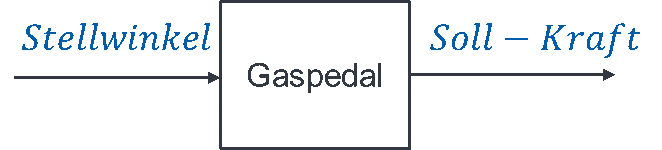
The accelerator pedal specifies what force the engine should deliver. The input quantity of the accelerator pedal is the pedal angle; the output quantity is the force demand on the engine. We can model the accelerator pedal as a function block as follows:
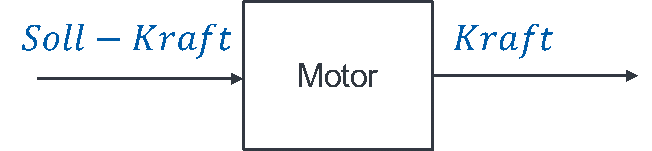
The engine as a block, as I have defined it, outputs a force onto the drive axle. This is a moment. Simplified, a moment is a turning force. The engine can be modelled as follows:
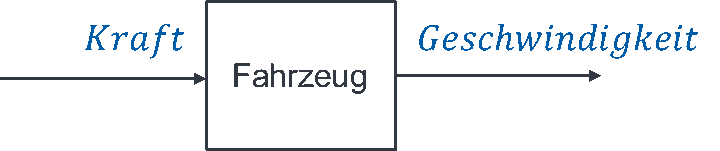
The chassis, or the vehicle, converts the force into a speed. It is modelled as follows:
If these three blocks are connected in series, you obtain a simple model of a car with the aim of modelling its speed.

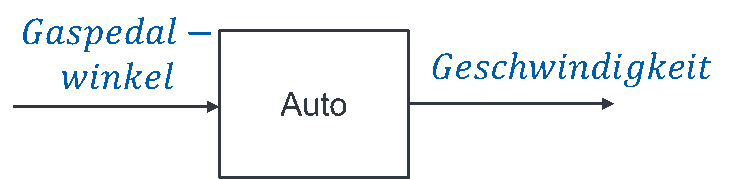
For speed control you need a more compact model with one input (accelerator pedal) and the speed as output. We can combine the whole car into one block, the “system” car:
In modelling, you are free to choose how detailed you want to represent reality. Results calculated with the model are of course closer to real behaviour if your model is more detailed. During the tutorial you will develop a feel for which level of detail is needed where in order to achieve the goal. For now it is enough that you know how modelling works in principle.
The simplest model of the water tank whose fill level is to be controlled looks like this:

Actuators
In control engineering you have to act on the system somehow so that it changes its behaviour at the output. Otherwise the system cannot change its output quantity. We call a function block through which the output can be influenced an actuator. The actuator in the car is the engine, because it receives a signal at its input (force demand) that changes a quantity in the system at its output (force on the axle).
One of the actuators in the human body is the skin. It is controlled by the brain and changes the system with regard to temperature. It sweats to cool, and forms goosebumps to lose less heat.
In control engineering, the actuator is usually modelled as a separate block.
Plant
Defining the plant is difficult. It is often modelled as the rest of the system without the actuator. The plant in speed control is the car without the engine. The plant is driven by the actuator. The output quantity of the plant is the controlled variable of the system.
Disturbances
Disturbance variables only make sense when modelling entire systems. Disturbances often have the unpleasant property of changing constantly. One example is the gradient of the road in speed control in a car. The gradient acts on the controlled variable of the system – the speed. Unlike the setpoint, however, it is not specified by the user. In body temperature control, the outside temperature, for example, is a disturbance. If you want to set the temperature in a room with a heater, an open window would be a disturbance.
In control engineering, only those disturbances are considered that act directly or indirectly on the controlled variable. The volume of the radio in the car may be disturbing, but it does not act on the controlled variable speed and is therefore not modelled or taken into account in speed control.
Measurement
If systems are to achieve the goal controlled variable = setpoint despite disturbances, quantities must be measured.
A person measures their body temperature internally. Deviations from the setpoint are registered by this measurement, and the person reacts by driving their actuators differently (heating or cooling).
In the car, the current speed is measured with the speedometer. If the speedometer measures too high a speed, the cruise control reduces the throttle so that the speed falls.