Slope
The slope of a characteristic curve can deviate from the desired slope. Then the deviation increases with the physical quantity. Mathematically, it is described by the parameter m in the straight-line equation y = m ∙ x + b.
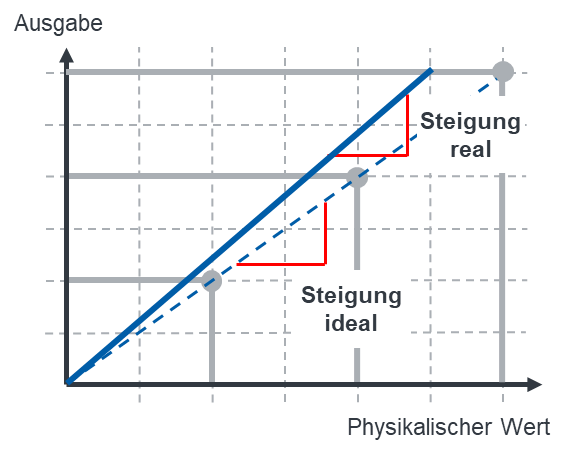
To compensate for an incorrect slope, the offset must have been compensated first. If the slope is too high, we have to multiply the output quantity by a factor smaller than 1. If the slope is too small, the factor is greater than 1. A multiplication by the factor 1 leaves the function unchanged.
To determine the slope, we place a test mass whose value we know exactly (e.g. 10 kg) on the scale. It is important here that the offset has been corrected beforehand. If the scale then shows, for example, 11 kg, we have to correct the output value by the factor 10/11. In the source code of a microcontroller, we need the command lines
Offset_Kompensierter_Wert = Unkompensierter_Wert – Offset
Steigungs_Kompensierter_Wert = Offset_Kompensierter_Wert ∙ Faktor
(slope-compensated value = offset-compensated value ∙ factor)
You determine the factor from the formula
For the following errors in characteristic curves, I assume that offset and slope have already been compensated.