Closed-Loop Control
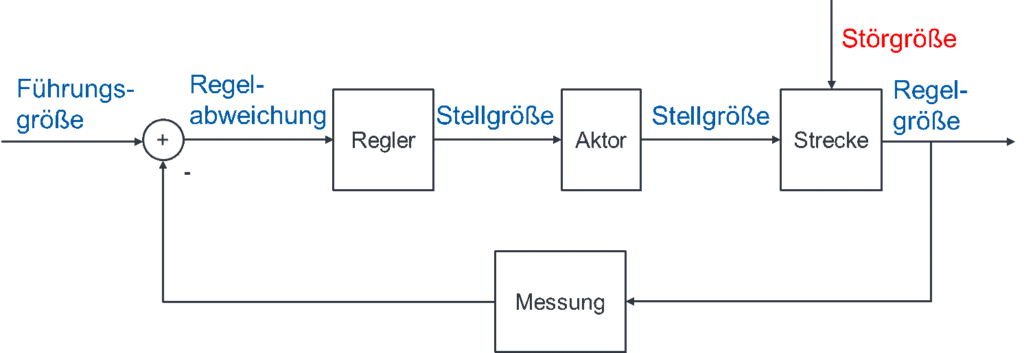
In closed-loop control, only the controlled variable of the system is measured instead of the disturbances. The central calculation unit is called the “controller”. It calculates the correct actuator drive signal from the reference variable and the controlled variable. If disturbances influence the controlled variable, it is sufficient to measure the controlled variable itself. In this way, all disturbances are also captured indirectly. The general control loop is modelled as follows:
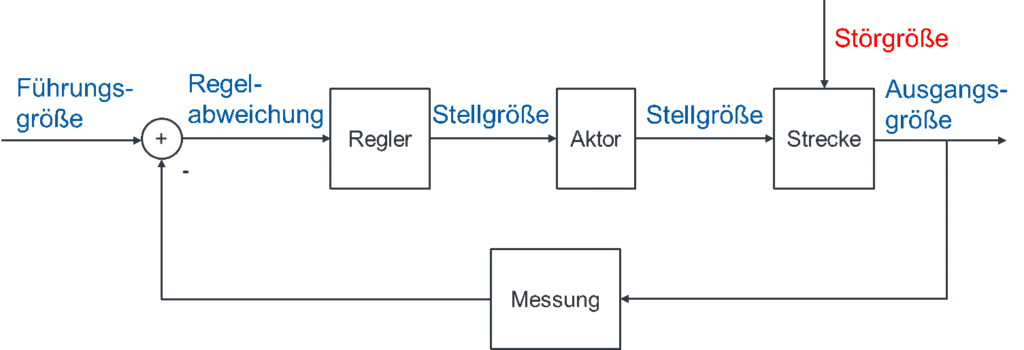
The user specifies the setpoint of the controlled variable as the reference variable. The controlled variable is measured. The difference between reference variable and controlled variable is called the “control error”. Control error = reference variable − controlled variable applies. It is a measure of how well the control works, i.e. how well the goal controlled variable = reference variable is achieved.
If the goal is achieved 100 %, controlled variable and reference variable are equal. Then the control error is 0. If the controlled variable is too high, the control error is negative. If the controlled variable is too low, the control error is positive. If the controlled variable is too large, a negative value is present at the controller. The controller then drives the actuator less strongly. As a result, the controlled variable falls.
The larger the control error, the more strongly the controller counteracts by driving the actuator harder in the required direction. In this way, the system keeps itself stable without external intervention. Whatever causes the controlled variable to no longer match the reference variable leads to a control error. This is detected by the controller, which drives the actuator until the control error disappears. Deviations between controlled variable and reference variable arise when the user specifies a new reference variable or when disturbances act on the system.
Example: speed control:
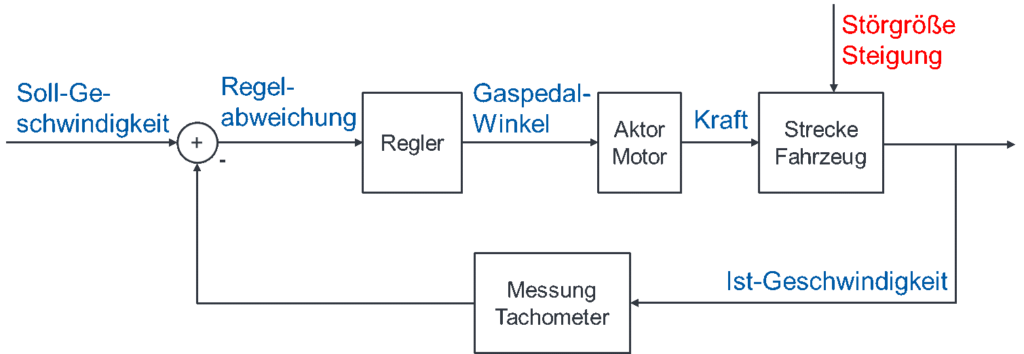
If the speed control of a car is modelled according to the scheme of the general control loop, we replace general blocks and signals with specific terms. Suppose you want to drive at 80 km/h. Then the reference variable target speed is 80 km/h. However, the car is only driving at an actual speed of 70 km/h. This is measured by the speedometer and subtracted from the setpoint. The control error is thus the difference between target speed and actual speed. The controller sets the accelerator pedal so that more throttle is applied when the actual speed is too low and the control error is therefore positive. As a result, the actual speed at the output of the plant increases. This continues until the control error disappears.
Now the car drives down a hill and the actual speed rises too much. This gives us a negative control error due to a disturbance. The controller now reduces the pedal angle (a digital quantity in the control unit, not a real change of angle), and the car reduces its actual speed until the control error disappears.
A pleasant feature of closed-loop systems is that you no longer have to calculate the system completely. You do not need to know which pedal angle is “right” for which gradient. It is enough to adjust the angle blindly until the control error disappears. This reduces complexity dramatically. It also does not matter which disturbance causes a deviation of the output quantity; the controller will simply compensate for it.
Summary
For complex systems, closed-loop control is much simpler than open-loop control. This applies especially to systems with many disturbances that change constantly. In closed-loop control you measure the output quantity and compare it with the reference variable. The controller ensures autonomously – i.e. without external intervention – that the control error disappears and thus the goal of control engineering is achieved: controlled variable = reference variable.
In closed-loop control you usually leave the system unchanged. You only add the measurement, the comparison element (minus) and the controller. If BMW commissions you to design the speed control of a car, you cannot simply change the engine because it might suit your control. So actuator and plant are normally fixed. Within the structure of the control loop, you can only change the “controller” block. It usually consists of a microcontroller with a lot of software.
The general control loop with general designations looks like this: