Phase Analysis
With a pendulum, it matters at what moment and in which direction it is pushed. The same push can accelerate or brake the pendulum, depending on when it happens.
Suppose the pendulum is currently moving from right to left. If we now push the pendulum from the right with a force F, the motion is accelerated and the energy in the system increases. If, during the movement from right to left, we push it with a force directed to the right, we brake the pendulum. So it matters that the push happens at the right moment in the right direction.
For periodic processes, it is better to give relative time information as a phase angle than as a time shift. If, for example, something should always happen at the maximum of a sine, it should happen at the phase π/2. The phase is independent of frequency. If we gave this shift as a time, we would need a different time value for each frequency. So at what phase should we push the pendulum to accelerate it? Please watch the third video again:
Later we want to transfer what we have learned about oscillations to control loops. For this, let us already have an actuator exert a continuous, sinusoidal force on the pendulum. The control loop is not yet closed; we only consider an actuator and the pendulum as the plant.
To determine the right phase for driving the pendulum, we first look at the direction of the pendulum’s motion. If the pendulum swings from right to left, the force should act from right to left. If it acted the other way round, the pendulum would be braked. The following force curve results:
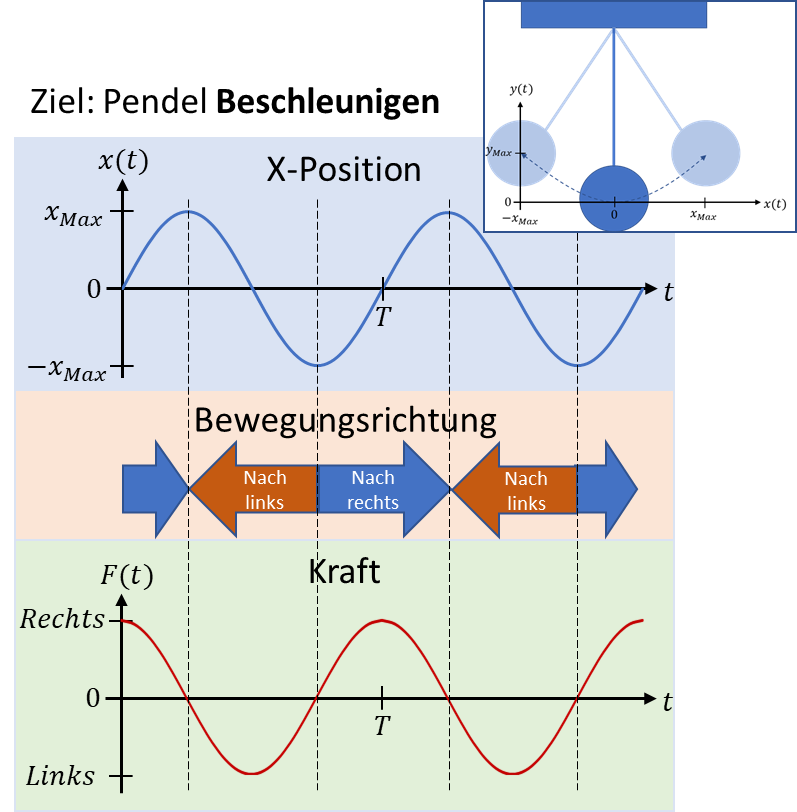
First we want to drive the pendulum. If the force is always to be directed in the direction of the pendulum’s motion, it must be shifted by 90° or π/2 to the left relative to the x-position of the pendulum (it leads the position, phase +90°). If the pendulum is to be braked, the force must be shifted by 90° or π/2 to the right (it lags, phase −90°).
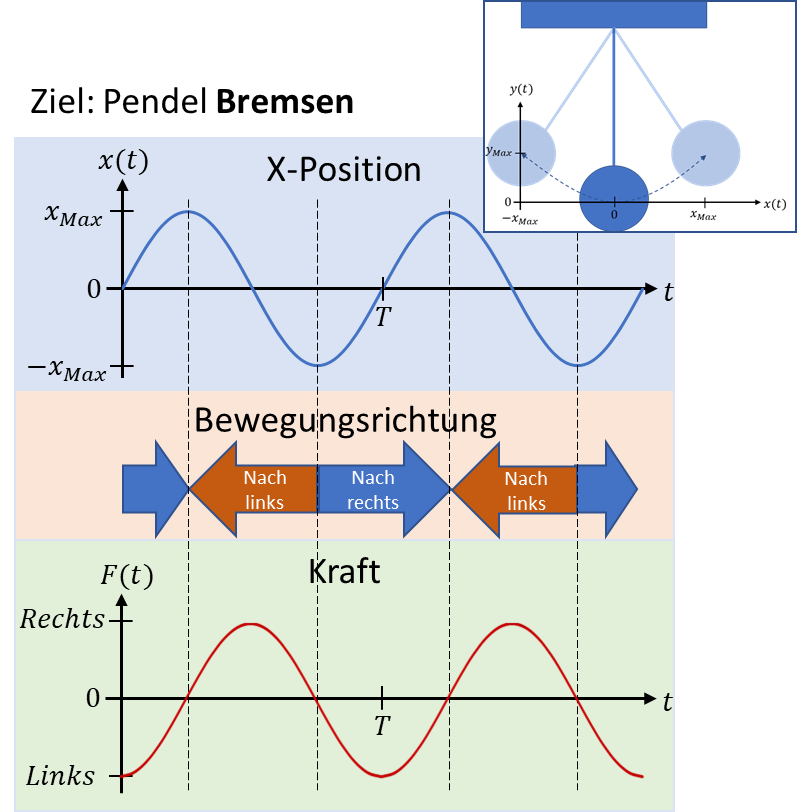
We can change the peak value of the oscillation by having the actuator drive the oscillating system with a certain phase. If we brake the pendulum, the peak value of the oscillation decreases, and vice versa.
If we use phases between +90° and −90°, the pendulum is braked or accelerated proportionally more. There are then alternating periods of braking and accelerating. Here are a few graphs:
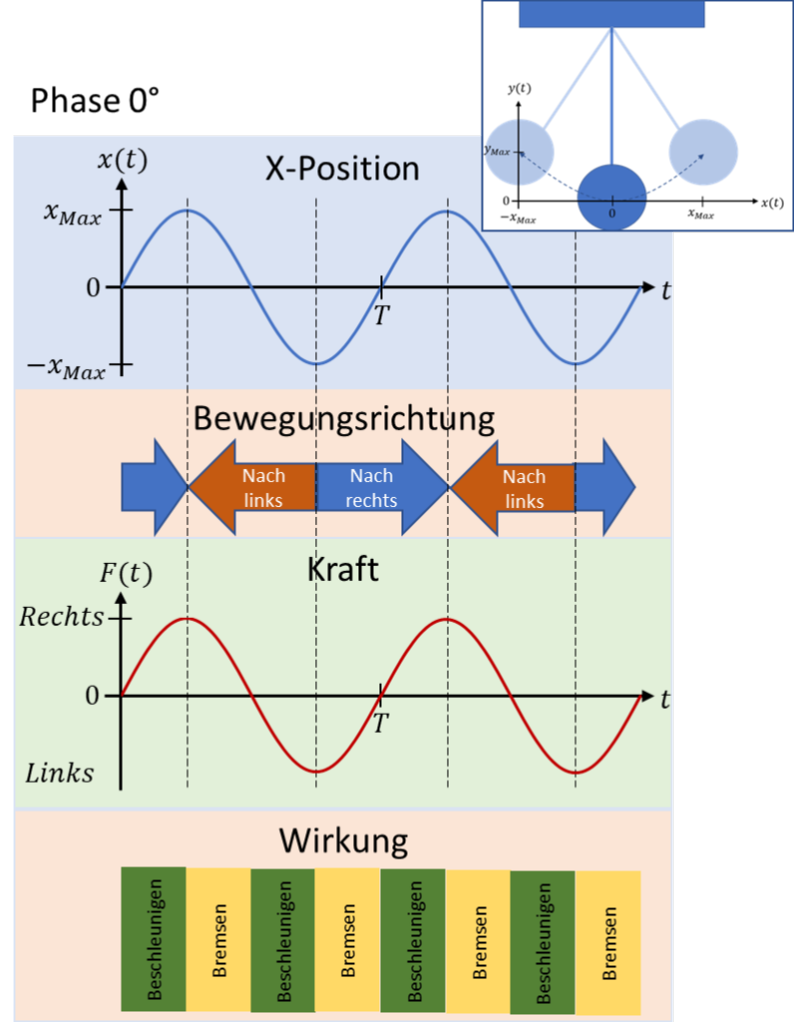
With 0° phase shift, the pendulum is on average neither accelerated nor braked.
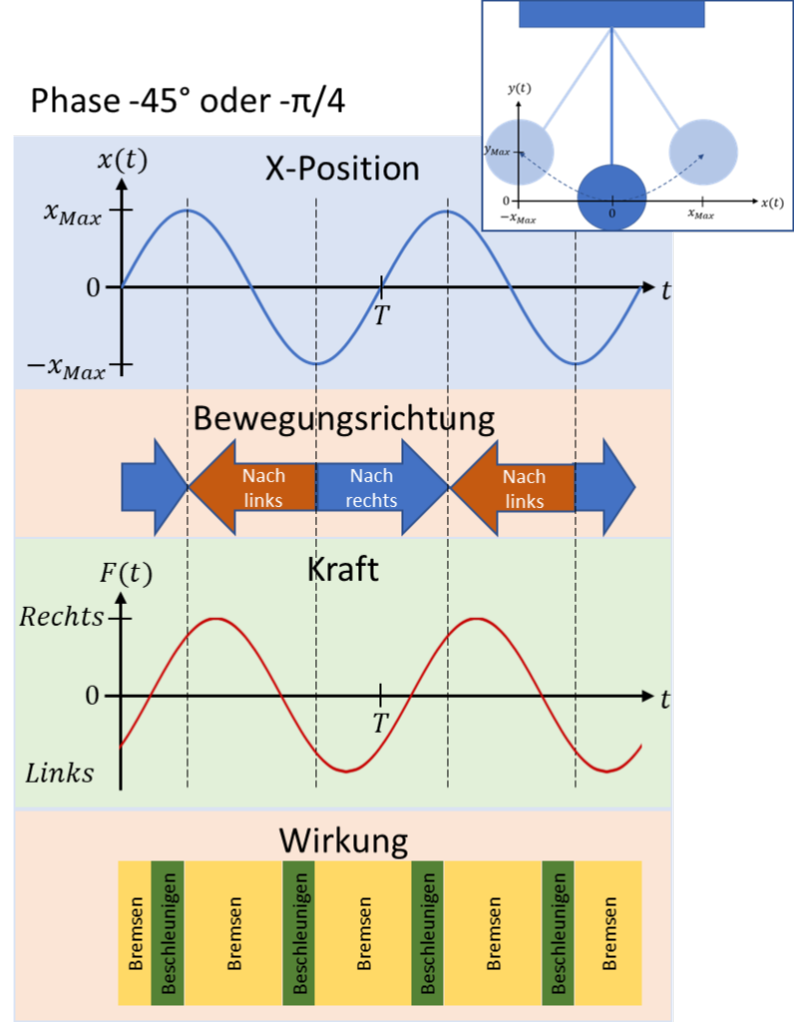
With −45° phase shift, braking predominates, because −45° is close to −90°. At −90° the pendulum is braked continuously.
The intensity of braking and pushing can of course also be varied via the peak value of the force. Regardless of the peak value, the following applies to the phase between x-position and force: