Conductivity Measurement
Your task in this section is to measure the conductivity of a liquid. From the conductivity you can draw conclusions about biological or chemical processes. The conductivity of blood, sweat or saliva, for example, allows conclusions about body values. How is conductivity measured? Please watch the first video on the following website (in German).
In this course we look at conductive conductivity measurement. For this, we apply an AC voltage to two electrodes and measure the alternating current that flows between the electrodes.
Why does DC voltage not work? We simplify the electrodes to two plates facing each other. The medium is between the plates. The conductivity of the medium determines the electrical resistance between the plates. That is what we want to measure.
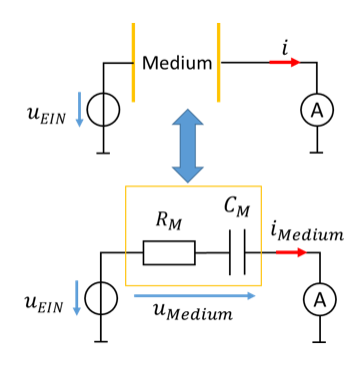
If we apply a DC voltage between the plates, electrolysis occurs. Ions from the medium accumulate on the plates. These form a layer around the plates that is not (or only very poorly) electrically conductive. A capacitor consists of two surfaces with non-conductive material between them. So the plates form an unwanted or parasitic capacitor. Reality is somewhat more complex, but we reduce the problem to this model.
A capacitor has an infinitely high impedance at DC voltage. Please read the chapter on the frequency dependence of impedance again. So with DC voltage no current flows through the capacitor. Because the resistor and the capacitor are connected in series, no direct current flows through the resistor either. Because of the accumulation of ions on the plates, no direct current flows.
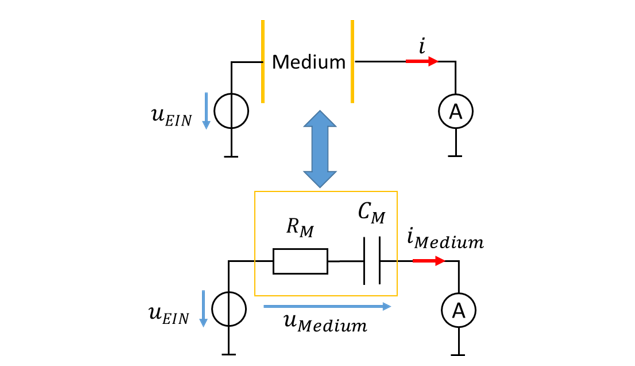
The accumulation of ions is prevented by applying an AC voltage to the plates. The frequency of the AC voltage is chosen higher than the speed at which the ions move towards the plates. The ions then still move back and forth between the plates without a non-conductive layer being able to form. From the AC voltage and the alternating current of the ions in the medium, we can determine the conductance G of the medium and from it its conductivity.
So we reluctantly use an AC voltage. That makes things more complicated. Then we also have to measure an alternating current. We generate the voltage ourselves with a source. So we know the peak value, phase and frequency of the voltage. We measure the current. So we also know its peak value, phase and frequency. We then determine the impedance of the medium using the complex form of Ohm’s law:

We obtain the desired conductance of the medium from the real part of the quotient of the measured current divided by the specified voltage. This is done in a microcontroller. At the end of next semester, in the subject Embedded Systems, we will program the solution using a microcontroller. Until then, in the subject Measurement Technology, we limit ourselves to measuring the alternating current.
In the next sections we deal with generating an AC voltage and measuring the current.