Ideal Current Source
A current source provides a fixed current. One example of a real current source is a solar cell under constant solar irradiation. The current at the output of the current source is always the same. The voltage adjusts itself as determined by the connected loads.
Modelling
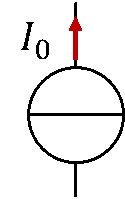
In an electrical circuit diagram, a current source is drawn as a circle with a horizontal line. On the conductor above this symbol for the source, an arrow for the direction of the current and a label must always be used. The source has two terminals above and below the circle, to which other components can be connected.
In an example, a resistor with R = 10 Ω is connected as a load to this ideal current source with I0 = 10 A. This is modelled as a simple circuit in a circuit diagram as follows: the current source is connected to the resistor by conductors.
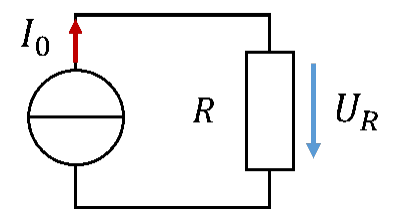
The following voltage arises across the resistor:
The voltage across the load is not specified directly by the current source; it takes on a different value depending on the load resistance. The current source only ensures that the current I0 always flows at its terminals.
The current source is the reciprocal component to the voltage source. What applies to the voltage at the voltage source applies to the current at the current source. The current source specifies the current in the circuit, and the voltage adjusts itself depending on the load. The voltage source specifies the voltage in the circuit, and the current adjusts itself depending on the load.