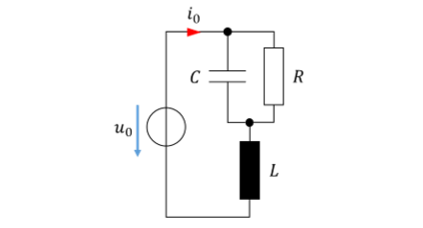
So far, you have calculated networks with DC voltage and direct current. You have got to know laws and rules for this. They all also apply in AC networks. Only there you calculate with complex impedances, complex voltages and complex currents.
As an example, let us look at the following network:
\[ \omega = 10\,\mathrm{k}\frac{1}{\mathrm{s}};\; u_0(\omega) = 5\,\mathrm{V};\; R = 3\,\Omega;\; C = 33\,\mathrm{\mu F};\; L = 150\,\mathrm{\mu H} \]
Just as with DC networks, we can first calculate the source current i0 and then the voltages and currents at the components. Let us first combine the impedances:
In the calculation above, we had to divide two complex numbers. I have shown you two ways of doing this: converting into exponential form and multiplying numerator and denominator by the complex conjugate of the denominator.
In the example, the impedance is purely real overall, because the imaginary parts of the inductor and the capacitor cancel each other out exactly. This is not the case in all problems, only in this example. Then we calculate the source current and all currents and voltages in the network from the total impedance:
This completes the calculation of all voltages and currents at the components in the network. You can see that the difficulty lies mainly in calculating with complex numbers. A good calculator can do that for you today.