Inductor and Resistor
If an inductor is used as a store, the curves of voltage and current look similar to those of the capacitor. The relationships between voltage and current at the inductor with resistor are reciprocal to those at the capacitor with resistor.
Before we dive into calculation and theory, here is a really good video (in German) on the basic function of an inductor with a resistor.
We again consider the series connection of an ideal voltage source, a switch, a resistor and an inductor. The switch is initially open and no current flows in the inductor. Then the switch is closed and the inductor is connected to the source.
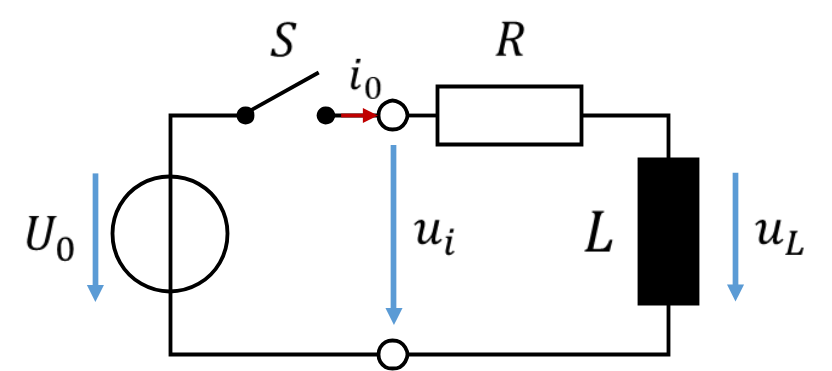
The mesh equation contains the current once linearly and once as a time derivative. Again, we have a differential equation. The solution is similar to that for the capacitor and resistor.
If a positive voltage is applied to an inductor with a resistor in series, the inductor current rises exponentially. If a negative voltage is applied, the current falls exponentially. The time curves of voltage and current look like this:
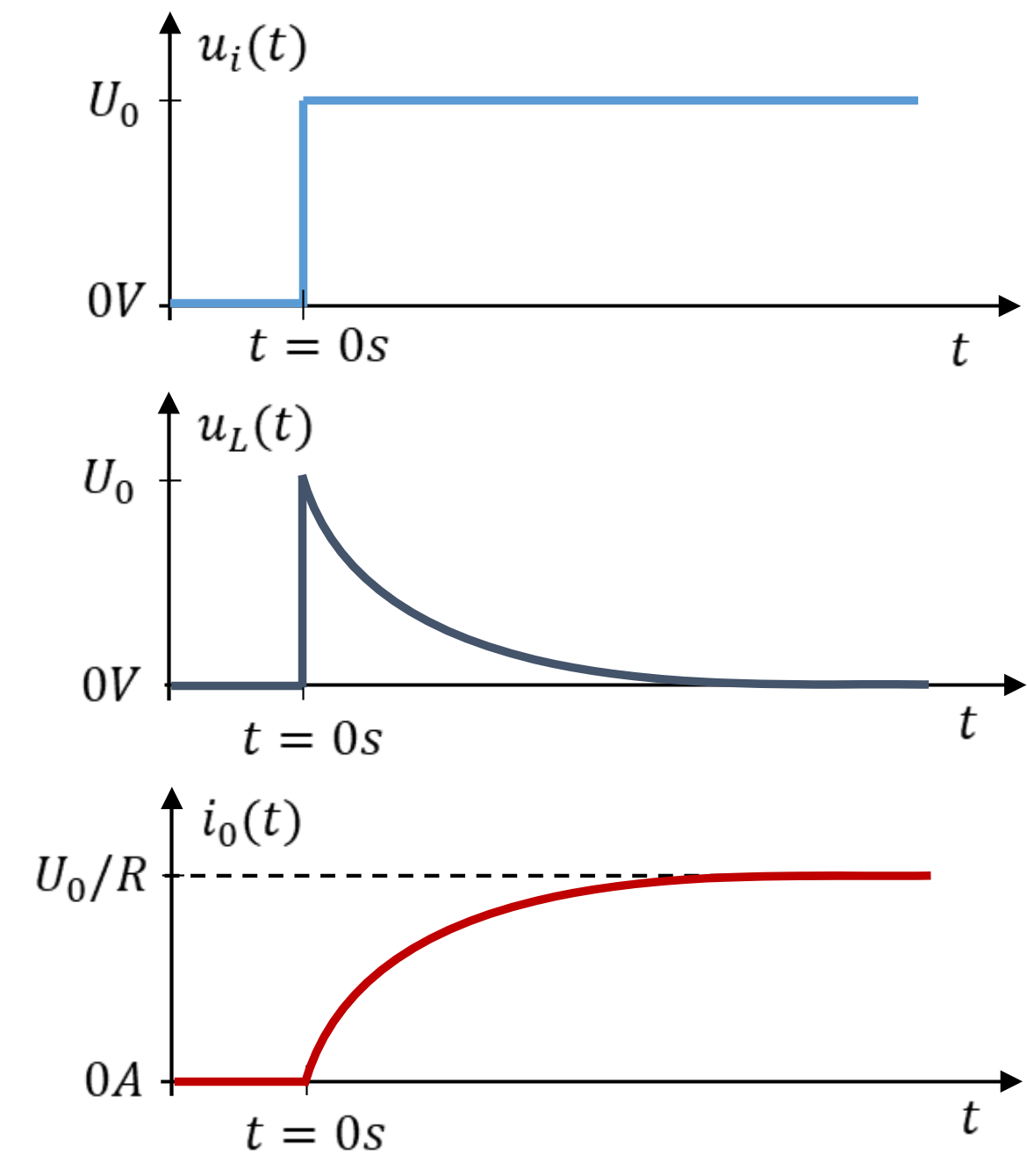
The current is limited to U0 / R. The maximum current only flows after some time. Because no current flows at first, the voltage across the resistor is 0 V. The larger the current becomes, the larger the voltage across the resistor. As a result, the voltage across the inductor decreases. The inductor voltage determines the slope of the current. Because the inductor voltage decreases during the charging process, the current curve becomes flatter and flatter until, at the end, the current no longer rises at all.
Optional: comparison of an inductor with and without a resistor
Note: this section up to the end of the chapter is not relevant for the exam.
Let us look again at the circuit from the chapter on inductors. The inductor was used to smooth the current. It was operated on a square-wave source whose output voltage is shown in blue over time.
We now compare the curves of voltage and current at the inductor in the cases
a) source and inductor, and
b) source, inductor and resistor.
The current curves in the two circuits look like this:
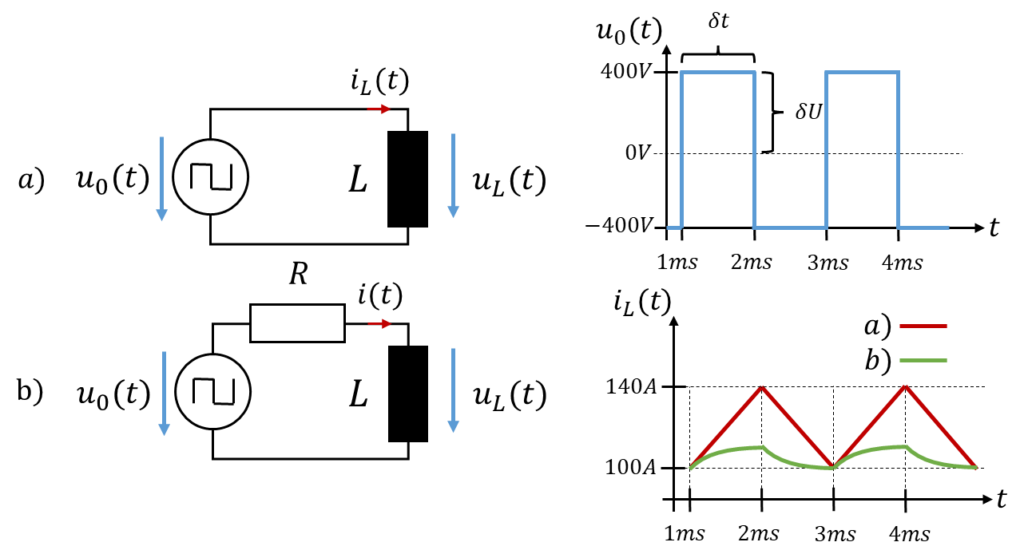
The inductor current is calculated from the integral of the inductor voltage. If there is no resistor in the circuit, the square-wave voltage becomes a triangular current. The current in the inductor is not limited. As long as the voltage is positive, the current keeps rising.
A resistor limits the maximum current in the inductor. Because voltage drops across the resistor, the inductor voltage decreases as the current increases. In this way, the inductor chokes off its own current. The green current curve is lower than the red one, because the inductor voltage is smaller with a resistor than without. The current curve with a resistor shows the typical charging and discharging processes of a store with a limiter in series. You have already seen these curves for capacitors.
The curves are not optimised using the equations of voltage and current. Only the parameter τ is changed. τ sets the speed of the charging and discharging processes. So you change the component values of R and L, and τ changes with them. The basic shape of the curve results from the circuit configuration; you do not change it in this way.
Further information
YouTube 1
YouTube 2
YouTube 3
Applied electrical engineering (in German)