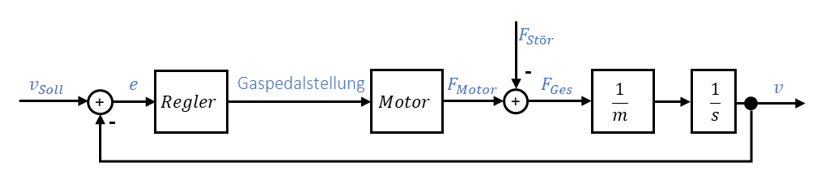
In both examples in the previous chapter, the disturbance acts before the integrator, i.e. to the left of it. In practice, disturbances often act before the integrator of the plant. This affects the disturbance response. Let us look at speed control.
To investigate the disturbance response, we build the system into a control loop with a P controller with kPR = 1. For simplicity, we assume P behaviour with kPA = 1 for the engine as actuator. We simplify the factor 1/m with m = 1 to the plant behaviour kPS = 1. To calculate the disturbance response, we set w = vSoll = 0.
Gaspedalstellung = accelerator pedal position · Regler = controller · Ges = total · Stör = disturbance
\[
\begin{gathered}
\text{Disturbance } d = -F_{\mathrm{Stör}} \text{ (in the block diagram, } F_{\mathrm{Stör}} \text{ is subtracted)} \\[6pt]
y = \frac{1}{s} \cdot K_{PS} \cdot (F_{\mathrm{Motor}} + d) \\[6pt]
F_{\mathrm{Motor}} = K_{PA} \cdot K_{PR} \cdot e \\[6pt]
e = w - y = -y \\[6pt]
y = \frac{1}{s} \cdot K_{PS} \cdot \bigl(K_{PA} \cdot K_{PR} \cdot (-y) + d\bigr) \\[6pt]
y \left(1 + \frac{1}{s} \cdot K_{PS} \cdot K_{PA} \cdot K_{PR}\right) = \frac{1}{s} \cdot K_{PS} \cdot d \\[6pt]
y = \frac{\frac{1}{s} \cdot K_{PS}}{1 + \frac{1}{s} \cdot K_{PS} \cdot K_{PA} \cdot K_{PR}} \cdot d = \frac{1}{\frac{1}{K_{PS}} \cdot s + K_{PA} \cdot K_{PR}} \cdot d \\[6pt]
H_{\mathrm{SU}} = \frac{y}{d}\Big|_{w=0} = \frac{1}{\frac{1}{K_{PS}} \cdot s + K_{PA} \cdot K_{PR}}
\end{gathered}
\]
We obtain the disturbance response in the steady state with s = 0. Then:
A control error remains in the steady state, even though a storage element is built into the system. For the reference response, the control error always tends to 0 if a storage element is contained in A. Why is that?