Calculating an Operating Point
With an electrical machine, we specify a drive torque. The drive torque changes the speed. It is like driving a car. With the accelerator pedal you do not set the speed. You vary how strongly the car accelerates. In a car, too, you specify a drive torque, i.e. a force. The speed then depends on engine power, gradient, vehicle weight and so on.
The speed is contained in the parameter ω = 2πf. The frequency f indicates how often the motor shaft turns per second. In an electrical machine, the speed of the shaft is measured by a speed sensor. So the parameter ω is known for controlling the machine.
Let us look at all the important equations from the last chapters:
As an example, let us consider an electric car. It is driven by an electrical machine. The energy is stored in a battery. Let us first look at the battery:
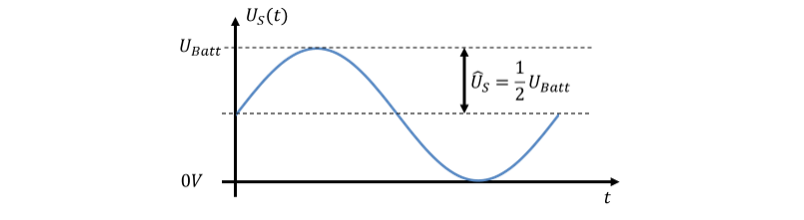
The inverter generates the (AC) stator voltage from the available (DC) battery voltage. Simple control methods allow a peak value of the AC voltage equal to half the battery voltage. Note: in the subject of power electronics you will learn how the peak value of the stator voltage can be increased further by clever control of the machine.
The following example values are available for the car’s electrical machine:
The machine parameters are not constant. In practice they depend on the current, the angular frequency ω and the temperature. That is why these parameters are stored in the motor control unit in the form of characteristic maps. We calculate this example with constant values.
Determining the target stator current
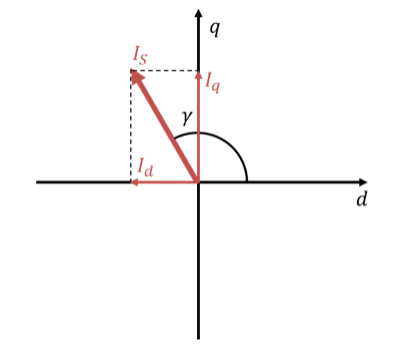
The car already has a speed v. There is an example measured value of ω = 800 1/s, which is proportional to the speed. You press the accelerator and thus specify a target torque to the machine. From the torque equation you obtain a target stator current by inserting all parameters:
Determining the stator voltage
By inserting the current values into the mesh equation, we obtain the corresponding stator voltage:
Field weakening
With a fully charged battery (400V), the inverter can provide the required voltage. If the battery is empty (300V), this is no longer possible.
With an empty battery we have to switch to field-weakening operation. For this, we increase the magnitude of the negative d-current so that the q-voltage decreases.
Increasing the d-current first reduces the q-voltage at the stator. In addition, the reluctance torque increases. As a result, the total torque increases. In field weakening we therefore always also get a higher torque. That is why the q-current can be reduced somewhat, which in turn reduces the stator voltage somewhat.
Through field weakening we have ensured that the inverter can generate the stator voltage even with an empty battery.
Summary
First, the required stator current is determined from the torque equation using the machine parameters, the target torque and the angular frequency. Then the stator voltage required for it is determined. If the stator voltage is greater than half the battery voltage, we have to invest additional negative d-current in field weakening. This additionally increases the reluctance torque, which is why the q-current can then be reduced somewhat.