Differential Signals
Differential signals are easy to explain with a beam balance. The beam balance shows the difference between two masses placed on its two sides. It only works with two masses that are compared. If you put something on one side only, it shows nonsense.
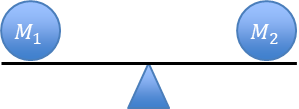
If you place equally heavy weights on both sides of such a balance, the balance is level and shows no difference between the weights. If one side is loaded with a heavier weight, the balance shows this difference. So it is not about the absolute weight on one of the sides, but about the difference between two weights.
Differential signals in measurement technology work in a similar way. A “normal” voltage signal that you measure against ground is, in the analogy, a weight that you place on one side of the balance. If you want to compare two potentials, you put one on the right and the other on the left of the balance. How high the individual potentials are above ground does not matter; only the difference between their potential values matters. This is a little like “weighing” charges: the balance tips towards the side where more charges are separated.
In the next chapter we look at a circuit that, like a balance, outputs a differential signal: the bridge circuit.