D Behavior
A system whose output differentiates the input shows “D behaviour”. The “D” stands for differentiation or derivative. D behaviour, or differentiating behaviour, is rare in practice. If you swap input and output in a system with I behaviour, you obtain the inverse function of the original transfer function as the new transfer function. The inverse of the integral is the derivative. So if, for example, we define the inflow of a bucket as the output and the fill level as the input, the system shows D behaviour.
A good example is the bicycle pump. It is a tank with input and output swapped. The input is the stroke of the piston, which you move by hand. It corresponds to the fill height of the pump’s compression chamber. Moving the piston reduces the height and air escapes from the outlet. The faster you move the piston, the more air escapes from the outlet. The following applies:
Again we use the Laplace transform to avoid the derivative. The transfer function of a general block with D behaviour is:
The characteristic parameter for describing D behaviour is kD. In the example above, kD = A (area). In the block diagram, a function block with D behaviour is modelled as follows:
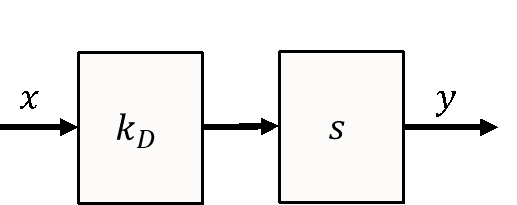
Whenever you see the factor s (not 1/s) in a block diagram, D behaviour is being modelled. The step response of D behaviour is difficult to draw. If an ideal step of duration 0 s in the input signal is differentiated, the result is infinite. We draw the step response as follows:
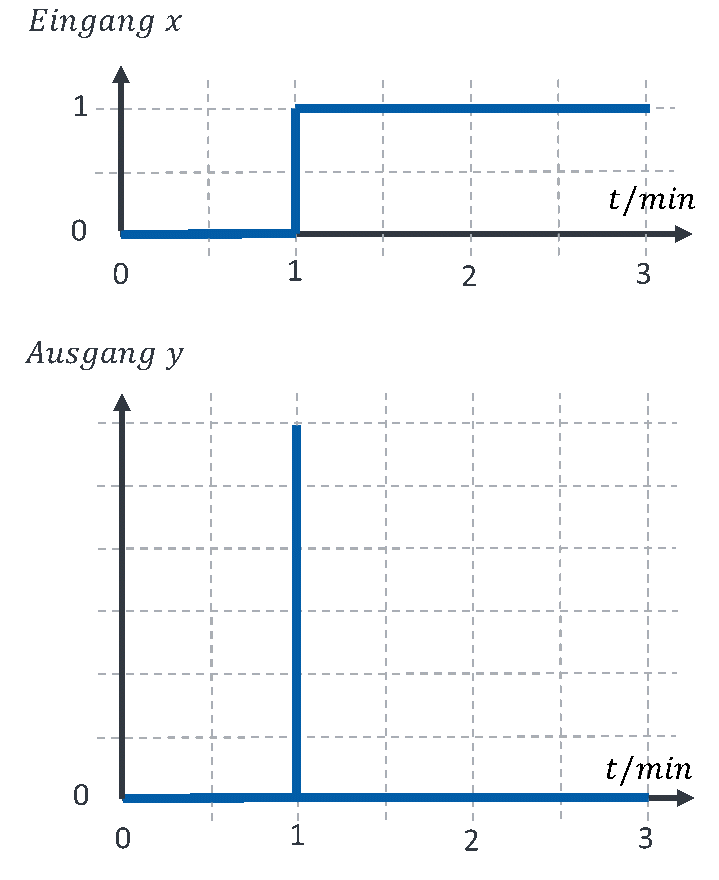
While the input is constant, the output = 0, because the derivative of a constant value is always 0. During the step, the slope of the input quantity is infinitely high. The output reacts by rising infinitely high. In real systems, the output jumps to a very high value, usually to the physical maximum of the output. How high this maximum is differs from system to system. After the step, the input quantity is constant again. The derivative at the output is 0 again.
We do not consider D behaviour in the control loop, because that would go beyond the time frame of the tutorial. A D component tends to make a controlled system react faster and settle with more damping. On the other hand, the D component amplifies high-frequency noise in the measurement signal.