Water Reservoir
Note: The chapter “Water storage” with its three subchapters is not relevant for the exam. It serves to explain how integral calculus works in an intuitive way. If you are not interested in this, continue reading from the chapter “Electrical energy stores”. You should at least read the subchapter “Graphical solution”, which helps you to solve exam problems on energy stores.
We begin the explanations of energy stores with water stores. Then we transfer the findings to electrical energy stores.
Let us look at a water bucket as a store for water. It is filled via a tap. In its bottom there is a drain through which it can be emptied via a tap. How does the fill level h of the bucket relate to the inflow and outflow of water?
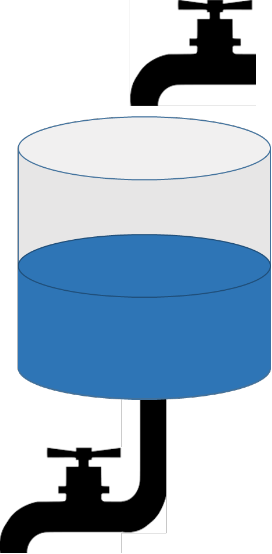
The fill level h rises when water runs into the bucket. The longer water flows in, the higher the fill level h afterwards. The more water flows in per unit of time, the faster the fill level h rises. If the inflow is stopped, the bucket keeps its current fill level.
If a swimming pool is filled with the same amount of water instead of the bucket, the fill level rises much more slowly; so there is a dependence on the base area A.
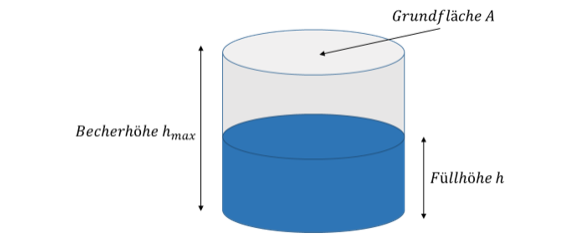
The behaviour described above is described mathematically by an integral. For a filling process between the times tStart and tEnde (end) with the inflow of water, the following applies:
The base area A of the bucket does not change. It is constant over time. It is therefore taken out in front of the integral.
The formula describes the water fill level h at the time tEnde. It depends on the fill level before filling, h0, present at the time tStart, i.e. just before the first drop of water reaches the bucket. In general mathematics, this is the parameter c in
Intuitively, the fill level results from the complete history of filling and emptying the bucket. The sum of the entire inflow minus the sum of the entire outflow gives the current fill level. We only need the previous fill level h0(tStart) if, out of laziness, we cut off the past and freeze it as the initial value of a new consideration.
The change during the filling process is described by the integral. The integration is over the time t, no longer over the general parameter x. When calculating with real quantities, units must be taken into account. The following units apply in the example above: