Calculating Disturbance Rejection
If the disturbance acts to the left of the plant’s integrator, we combine the blocks for calculating the disturbance rejection as follows: all blocks to the left of the disturbance d are combined into HLinks (left), and the blocks to the right of it are combined into HRechts (right). Staying with the bucket example, we have
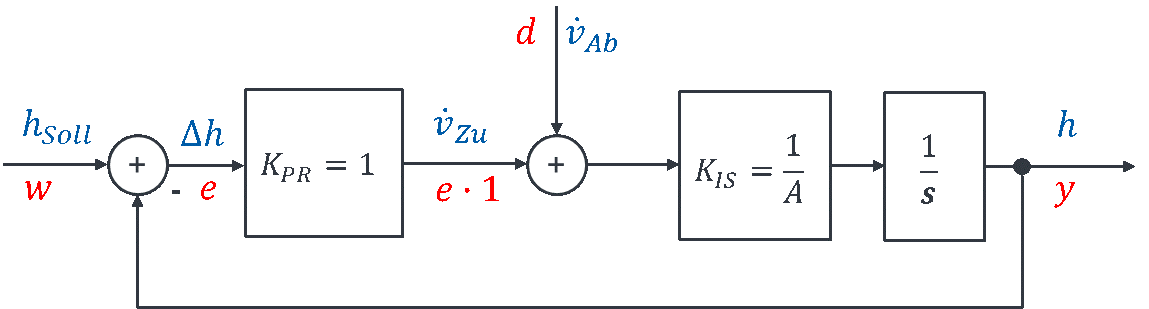
We calculate the disturbance rejection as follows:
Here the approximation
was used to simplify the term. This approximation always holds in the steady state for s = 0 if a storage element acts in the system to the right of the disturbance. With this approximation, the disturbance rejection is determined only by the blocks to the left of the disturbance. All blocks to the right of the disturbance therefore have no disturbance-rejecting effect. We reach the goal HSU = 0 (SU: disturbance rejection) by having an integrator act to the left of the disturbance. In practice, however, the integrator is in most cases to the right of the disturbance variable, so the integrator in the plant generally does not help you with disturbance rejection. To ensure e = 0, you then need an additional integrator in the controller.